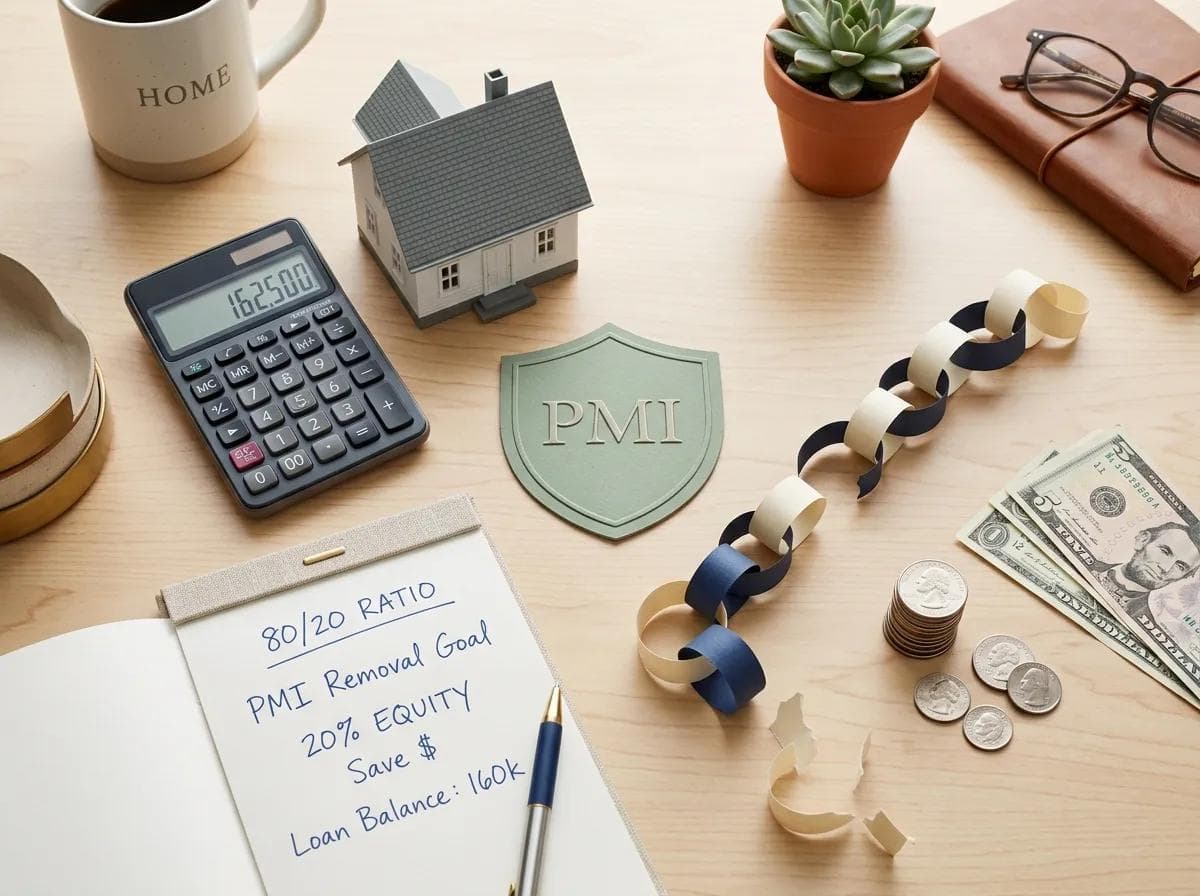
Private mortgage insurance (PMI) is a monthly fee added to your mortgage payment when your down payment is less than 20% on a conventional loan. It protects the lender — not you — if you default. According to the Urban Institute's Housing Finance Policy Center via Bankrate, PMI costs between 0.46% and 1.5% of your loan amount annually, or roughly $115–$375/month on a $300,000 mortgage. The good news: PMI is not permanent. It drops off automatically by law once your loan balance reaches 78% of your home's original value.
Quick Reference: 4 Ways PMI Goes Away
| Method | How It Works | Timeline |
|---|---|---|
| Automatic cancellation | Lender removes PMI when balance hits 78% LTV | ~8–11 years at standard payment pace |
| Borrower request at 80% | You request removal when balance reaches 80% LTV | Earlier than auto-cancel if you act proactively |
| Extra principal payments | Paying ahead builds equity faster, reaching 80% sooner | Depends on extra payment amount |
| Home appreciation + appraisal | Rising home values can push your LTV below 80% — request removal with new appraisal | Varies by market |
| Refinancing | New loan at 20%+ equity eliminates PMI requirement | When rates/equity make refinancing worthwhile |
What Is PMI?
PMI is insurance your lender requires when you borrow more than 80% of a home's value. It covers the lender's risk — not yours.
When you put less than 20% down, your lender is taking on more risk. If you stop making payments, they may not recover the full loan amount from a foreclosure sale. PMI solves that: it insures the lender against the gap between what they lent and what the home might sell for in a distressed sale.
The key thing most buyers miss: you pay the premium, but the lender receives the benefit. PMI does nothing to protect your investment or your credit if you default. What it does is allow you to buy a home with less than 20% down — which, for most first-time buyers, means getting into homeownership years earlier than saving a full 20% would allow.
PMI applies specifically to conventional loans. Other loan types handle mortgage insurance differently:
- check_circleFHA loans: Use Mortgage Insurance Premiums (MIP) — structured differently and required for the life of the loan if you put less than 10% down
- check_circleVA loans: No mortgage insurance at all (a significant benefit for qualifying veterans)
- check_circleUSDA loans: No monthly PMI, but an annual guarantee fee instead
How Is PMI Calculated?
PMI is calculated as an annual percentage of your loan amount — not the home's value — then divided into monthly payments.
The formula:
Monthly PMI = (Loan Amount × Annual PMI Rate) ÷ 12
Your actual PMI rate depends on three main factors: your credit score, your loan-to-value (LTV) ratio, and your loan type (fixed vs. adjustable rate). The better your credit and the more you put down, the lower your PMI rate.
Here's how that plays out on a $350,000 loan:
| Credit Score | Down Payment | LTV Ratio | Annual PMI Rate | Monthly PMI |
|---|---|---|---|---|
| 620–639 | 5% ($17,500) | 95% | ~1.50% | ~$438 |
| 640–679 | 5% ($17,500) | 95% | ~1.20% | ~$350 |
| 680–719 | 5% ($17,500) | 95% | ~0.90% | ~$263 |
| 720–759 | 10% ($35,000) | 90% | ~0.55% | ~$160 |
| 760+ | 10% ($35,000) | 90% | ~0.46% | ~$134 |
Estimates based on Urban Institute Housing Finance Policy Center data. Actual rates vary by lender and insurer.
A 140-point credit score difference can cut your PMI cost by over $300/month on the same loan. If your score is below 720, improving it before applying can save thousands over the years you carry PMI.
See your estimated PMI in the full payment breakdown →
When Does PMI Go Away?
PMI is legally required to cancel automatically when your loan balance reaches 78% of the original home value. You can request it removed earlier at 80%.
The Homeowners Protection Act (1998) established these federal rights for all conventional borrowers:
Path 1 — Automatic cancellation at 78% LTV: Your servicer must cancel PMI automatically on the date your balance is scheduled to reach 78% of the original purchase price, as long as your payments are current. On a 30-year loan with a 5% down payment, this typically happens in year 8–11.
Path 2 — Borrower-requested cancellation at 80% LTV: You can submit a written request to cancel PMI once your balance drops to 80% of the original value. Your lender may require a good payment history and, in some cases, a new appraisal confirming the home hasn't declined in value.
Path 3 — Midpoint cancellation: Even without reaching 80% equity, your servicer must cancel PMI when you're halfway through your loan term (15 years into a 30-year mortgage) — whichever comes first.
Path 4 — Appreciation-based cancellation: If your home has increased in value and your current balance is below 80% of the new appraised value, you can request PMI removal with a formal appraisal. This path has become common in markets that saw rapid home price growth.
Important caveat: Lender-paid PMI (LPMI) — where the lender covers PMI in exchange for a higher interest rate — cannot be cancelled this way. The only exit is refinancing into a new loan. Always clarify your PMI type before closing.
How to Avoid PMI Altogether
The clearest way to avoid PMI is to put 20% down. If you can't, you have three other options.
Option 1: Put 20% Down
No PMI, no exceptions, on conventional loans. For a $400,000 home, that's $80,000 upfront. If you can reach 20%, you'll also typically qualify for a slightly lower interest rate and start with immediate equity cushion.
Option 2: Use a VA or USDA Loan
If you qualify for a VA loan (veterans, active military, surviving spouses), you pay zero PMI — ever. USDA loans skip monthly PMI for rural and qualifying suburban purchases, though an annual guarantee fee applies. Both are powerful alternatives if you meet eligibility requirements.
Option 3: Piggyback Loan (80-10-10)
A piggyback loan splits financing into two: an 80% first mortgage (no PMI triggered), a 10% second mortgage, and a 10% down payment. This keeps the first loan at exactly 80% LTV, eliminating PMI. The tradeoff: the second loan carries a higher interest rate, and you'll have two monthly payments.
Option 4: Lender-Paid PMI at a Higher Rate
Some lenders offer "no-PMI" loans where they absorb the insurance cost in exchange for a permanently higher interest rate. Run the math carefully — if rates drop and you refinance, you could land in a better position, but if you stay long-term, you may pay more in interest than you would have in PMI.
Is PMI Worth Paying?
For most first-time buyers, yes — PMI is a worthwhile cost to enter homeownership earlier.
Here's the practical math: On a $350,000 home, PMI might cost $200/month. That's $2,400/year. But if the home appreciates 3% annually, it's gaining $10,500/year in value. The equity being built typically far outpaces the PMI cost — especially in the first years when you'd otherwise still be renting.
There's also a new tax benefit worth noting in 2026: The One Big Beautiful Bill Act permanently reinstated the PMI deduction starting tax year 2026. PMI premiums are now treated similarly to mortgage interest for deduction purposes, though income limits apply. Consult a tax professional to confirm your eligibility — but this meaningfully reduces the net cost of PMI for qualifying homeowners.
The buyers for whom PMI is hardest to justify are those who plan to sell within 2–3 years. If you're unlikely to reach the cancellation threshold before moving, weigh the total PMI cost against buying later with a larger down payment.
Related Tools & Resources
- check_circleMortgage Calculator — See your estimated PMI alongside your full monthly mortgage payment, interest, taxes, and insurance
- check_circleDown Payment Guide — How much you actually need to put down and how different amounts change your PMI obligation
- check_circleMortgage Calculator Guide — Understand the full mortgage payment formula: principal, interest, taxes, insurance, and PMI together
Final Thoughts
PMI isn't a punishment — it's a temporary cost that unlocks homeownership before you've saved 20%. Understanding how it's calculated, when it ends, and how to eliminate it early puts you in control of the timeline. For most buyers, the equity building during the PMI period far outweighs the monthly cost.
Run your own numbers to see exactly what PMI will add to your payment — and how different down payment amounts change the equation.
Calculate your PMI with our free Mortgage Calculator →
Disclaimer
This blog post is for informational purposes only and does not constitute financial, mortgage, legal, or tax advice. PMI rates, cancellation rules, and tax treatment vary by lender, loan program, credit profile, and jurisdiction. The PMI deductibility update referenced relates to the One Big Beautiful Bill Act as of mid-2026 — consult a qualified tax professional to confirm your eligibility. Always consult a licensed mortgage professional before making homeownership or financing decisions.