Most buyers don't put 20% down. According to Redfin's March 2026 data, the typical U.S. homebuyer put down just 15% — or $64,000 — on their home purchase, down from 16.1% the previous year. First-time buyers put down even less, with many using loan programs that require as little as 3% or zero down. How much you actually need depends on your loan type, credit score, and financial goals — not a fixed rule invented decades ago.
Quick Reference: Minimum Down Payment by Loan Type
The fastest way to answer "how much down payment do I need" is to identify your loan type.
| Loan Type | Minimum Down Payment | Best For | PMI Required? |
|---|---|---|---|
| Conventional (standard) | 3% | Strong credit (620+) | Yes, until 20% equity |
| Conventional (HomeReady / Home Possible) | 3% | First-time, low-to-moderate income | Yes, until 20% equity |
| FHA Loan | 3.5% (credit 580+) / 10% (credit 500–579) | Lower credit scores | Yes, for loan life |
| VA Loan | 0% | Veterans, active military, surviving spouses | No |
| USDA Loan | 0% | Rural/suburban areas (income limits apply) | No (annual fee instead) |
| Jumbo Loan | 10–20% | Loan amounts above $832,750 (2026 limit) | Varies by lender |
How Much Down Payment Do You Actually Need?
The minimum you need is 3% — or $0 if you qualify for a VA or USDA loan.
The "20% rule" originated from an era before mortgage insurance existed. Lenders required 20% down because they had no way to protect themselves if a borrower with less equity defaulted. Today, private mortgage insurance (PMI) solves that problem. It lets lenders approve buyers with smaller down payments by insuring the portion of the loan that exceeds 80% of the home's value.
What this means for you: there is no universal correct answer. The right down payment is determined by:
- check_circleYour loan program — each type has its own floor (see table above)
- check_circleYour credit score — higher scores unlock better rates with smaller down payments
- check_circleHow much cash you have — including reserves left after closing
- check_circleYour local market — competitive markets sometimes require larger offers to win
For most first-time buyers using conventional financing, 5–10% is a practical target. It reduces your loan amount compared to 3%, lowers PMI costs, and leaves enough cash in reserve for moving costs, repairs, and emergencies.
See how different down payments change your monthly payment →
Does Putting 20% Down Still Make Sense?
Yes — if you can do it without draining your savings. No — if it means buying with no financial cushion.
The benefits of a 20% down payment are real:
- check_circleYou eliminate PMI entirely, saving $100–$400/month on a typical loan
- check_circleYou borrow less, paying thousands less in total interest over the life of the loan
- check_circleYou start with more equity, giving you a buffer if home values dip
- check_circleYou may qualify for a slightly lower interest rate with some lenders
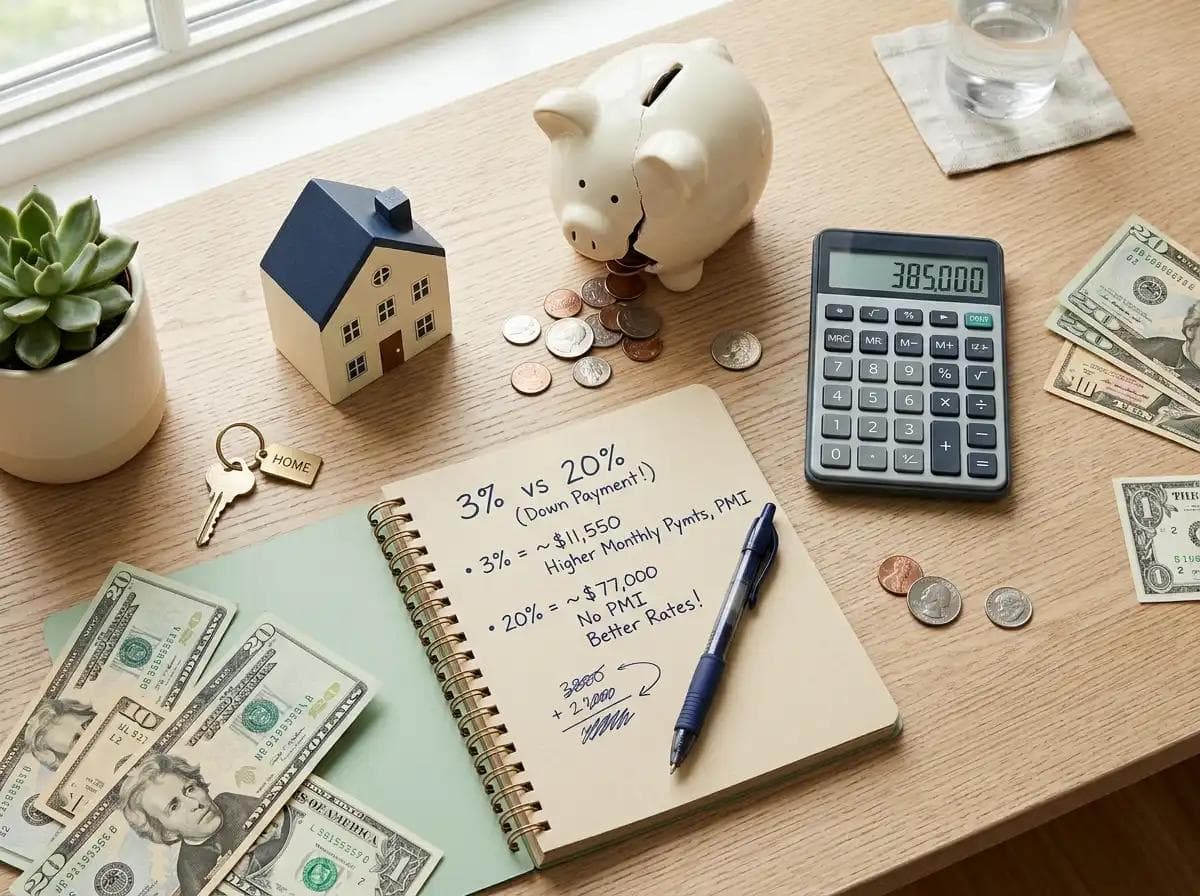
But 20% down has a cost too. On a $400,000 home, 20% is $80,000. That's a large sum to have locked up in one asset — capital that can't be used for investing, emergencies, or other financial priorities.
The smarter question is: what's the right balance between down payment and reserves?
A common rule of thumb: after closing, you should have at least 2–3 months of mortgage payments available in savings. If hitting 20% down means you'd close with near-zero reserves, a smaller down payment — combined with PMI — is often the safer financial choice.
What Does a Smaller Down Payment Actually Cost You?
PMI and a slightly higher interest rate — both of which are calculable, finite, and often worth paying.
Here's how your down payment affects a $400,000 home purchase at current rates:
| Down Payment | Amount Down | Loan Size | Monthly P&I | Monthly PMI | Total Monthly |
|---|---|---|---|---|---|
| 3% | $12,000 | $388,000 | ~$2,451 | ~$280 | ~$2,731 |
| 5% | $20,000 | $380,000 | ~$2,400 | ~$230 | ~$2,630 |
| 10% | $40,000 | $360,000 | ~$2,274 | ~$165 | ~$2,439 |
| 20% | $80,000 | $320,000 | ~$1,919 | $0 | ~$1,919 |
Assumes 6.1% interest rate, 30-year fixed. Property taxes and insurance excluded.
The difference between 3% and 20% down is roughly $812/month. But the 3% buyer only needed $12,000 upfront instead of $80,000 — preserving $68,000 for other uses. Over the years until PMI drops (typically when equity reaches 20%), the buyer who put 3% down pays more each month but retains far more capital flexibility early on.
Neither approach is wrong. The right choice depends on your timeline, income stability, and how quickly you expect your home to appreciate.
Use our Affordability Calculator to find what purchase price and down payment combination fits your budget.
How to Calculate Your Down Payment Target
Work backward from what you can comfortably afford each month — not forward from an arbitrary percentage.
Follow these five steps:
- Find your comfortable monthly budget — Most lenders recommend keeping housing costs under 28% of gross monthly income. On $6,000/month income, that's $1,680/month maximum.
- Add closing cost estimates — Budget 2–5% of the home price. On a $350,000 home, that's $7,000–$17,500.
- Reserve an emergency fund — Keep 2–3 months of housing costs liquid after closing.
- Calculate your max loan at your payment cap — Use our Mortgage Calculator to see what loan size fits your target payment.
- Down payment = Home price minus max loan — Whatever remains is your required down payment.
This method grounds your target in your actual financial situation rather than an abstract percentage. It also reveals whether buying now at 5% down makes more sense than waiting to save 20% while home prices continue to rise.
Related Tools & Resources
- check_circleMortgage Calculator — See exactly how your down payment changes your monthly payment, total interest, and loan size
- check_circleAffordability Calculator — Find the home price range you can realistically afford based on income and debts
- check_circleRent vs. Buy Calculator — Decide whether it makes more financial sense to keep renting while you save a larger down payment
- check_circleMortgage Calculator Guide — Understand how the full mortgage payment formula works, including principal, interest, taxes, insurance, and PMI
Final Thoughts
There is no single right down payment. The 20% rule is a guideline, not a requirement — and for most first-time buyers, it's neither realistic nor necessary. The actual minimum starts at 3% for conventional loans and goes to zero for VA and USDA programs.
What matters more than the percentage is the full picture: down payment + closing costs + reserves after closing. Run your numbers with our Mortgage Calculator to find the combination that gets you into a home without overextending financially.
Calculate your down payment with our free Mortgage Calculator →
Disclaimer
This blog post is for informational purposes only and does not constitute financial, mortgage, or professional real estate advice. Down payment requirements, loan eligibility, PMI rates, and assistance programs vary by lender, loan type, credit profile, and location. Always consult a licensed mortgage professional or HUD-approved housing counselor before making homeownership decisions. Statistics cited reflect available data as of mid-2026 and may change.