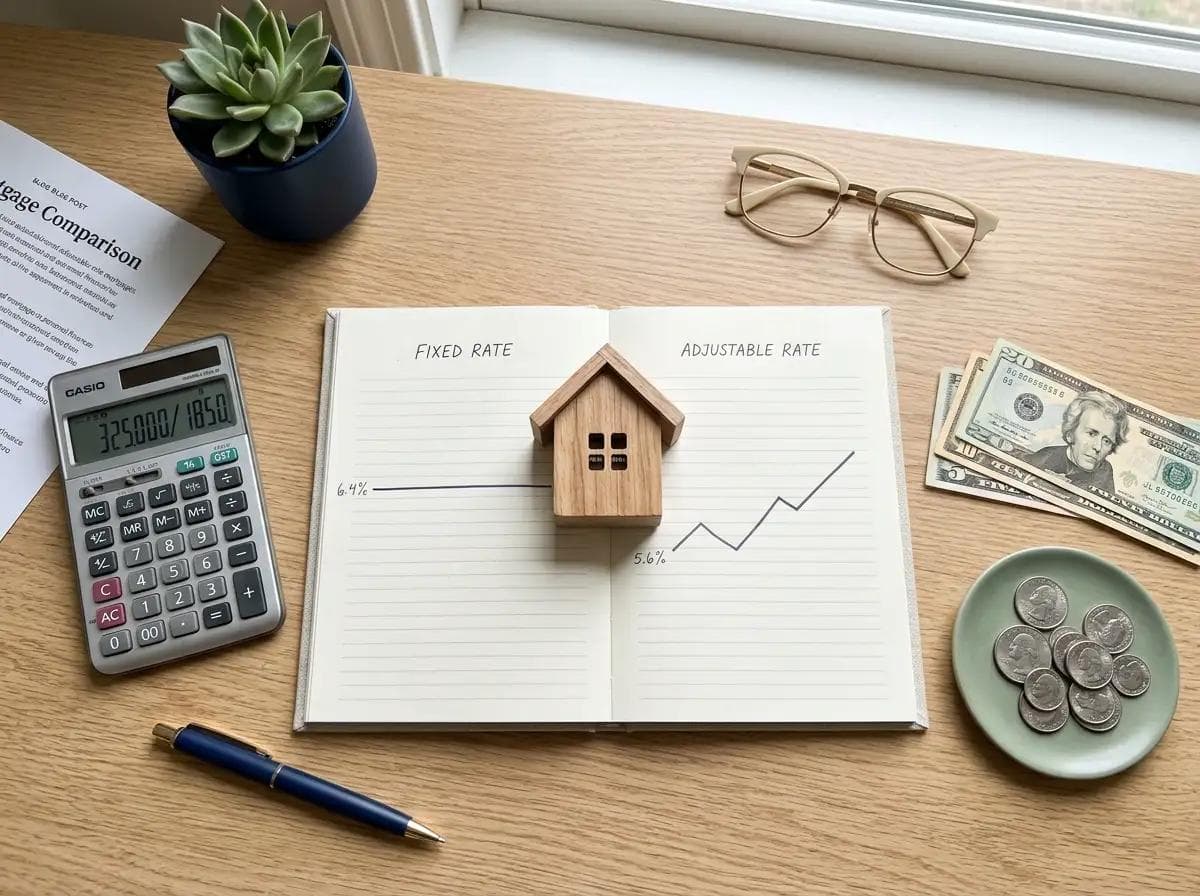
The right mortgage type comes down almost entirely to your timeline. A fixed-rate mortgage locks in your rate for the life of the loan — what you sign at closing is what you pay for 30 years. An adjustable-rate mortgage (ARM) starts lower and stays there for 5–10 years, then adjusts to market rates. In 2026, the average 30-year fixed-rate mortgage sits around 6.4%, while the average 5/1 ARM is 5.6% — a difference that translates to roughly $150/month on a $300,000 loan. Which one saves more depends entirely on whether you're still in that home when the ARM starts adjusting.
Run both scenarios side-by-side with our free Mortgage Calculator →
Fixed vs. Adjustable Rate Mortgage: Side-by-Side Comparison
| Factor | Fixed-Rate Mortgage | Adjustable-Rate Mortgage (ARM) |
|---|---|---|
| Interest Rate | Locked for life of loan | Fixed for initial period, then adjusts |
| Monthly Payment | Never changes (P&I) | Changes after initial period |
| Starting Rate (2026) | ~6.4% (30-year) | ~5.6% (5/1 ARM) |
| Payment Predictability | Full — budgetable from day one | Partial — predictable until adjustment |
| Best For | Staying 7+ years, rate stability | Moving/refinancing within 5–7 years |
| Risk Level | Low — no rate surprise | Moderate — payment can rise |
| Typical Rate Caps | N/A | 2% first adjustment / 2% annual / 5% lifetime (2/2/5) |
| Monthly Savings vs. Fixed | Baseline | ~$100–$300/month initially |
| Long-Term Cost (30 years) | Lower if rates rise | Higher if rates rise post-adjustment |
| Refinance Exit | Any time (closing costs apply) | Any time — common before adjustment hits |
| Ideal Buyer Profile | Long-term homeowner, budget-conscious | Short-term buyer, income-flexible, rate-strategic |
What Is a Fixed-Rate Mortgage?
A fixed-rate mortgage keeps your interest rate identical from the first payment to the last — regardless of what happens to rates in the market.
About 92% of U.S. mortgage holders have fixed-rate home loans — and for good reason. When you close on a 30-year fixed at 6.4%, that's your rate in year 1 and in year 27. If the Fed raises rates, your payment doesn't change. If rates fall, you can refinance into a lower rate.
Fixed-rate mortgages come in multiple terms:
- check_circle30-year fixed: Lower monthly payment, more total interest paid
- check_circle15-year fixed: Higher monthly payment, significantly less total interest, faster equity building
- check_circle20-year fixed: A middle-ground option with moderate payment and interest cost
The primary trade-off: fixed rates start slightly higher than ARM introductory rates because the lender is absorbing all the long-term rate risk on your behalf.
What Is an Adjustable-Rate Mortgage (ARM)?
An ARM starts with a lower fixed rate for an initial period — typically 5, 7, or 10 years — then adjusts periodically based on market indices.
Modern ARMs are described by two numbers: the fixed period and the adjustment frequency. A 7/6 ARM has a fixed rate for seven years, then adjusts every six months. A 5/1 ARM fixes the rate for five years, then adjusts annually.
After the initial period, your rate is recalculated using:
ARM Rate = Market Index (SOFR) + Lender Margin
The SOFR (Secured Overnight Financing Rate) changes with market conditions. Your margin — set by your lender at closing — never changes. So when SOFR rises, your rate rises with it; when SOFR falls, so does your rate.
Rate Caps: Your Protection Against Worst-Case Scenarios
Most ARMs carry a 2/2/5 cap structure:
- check_circle2% maximum increase at first adjustment
- check_circle2% maximum increase per subsequent adjustment
- check_circle5% maximum increase over the life of the loan
On a 5/1 ARM starting at 5.6%, your rate can never exceed 10.6% — ever. That worst-case ceiling matters when modeling total loan cost.
Which Costs More Long-Term? The Break-Even Analysis
Fixed-rate costs more initially; ARM costs more if you stay past the break-even point — typically around year 7–9.
Here's a worked example comparing a 30-year fixed at 6.4% vs. a 5/1 ARM at 5.6% (with rate rising to 7% after year 5) on a $350,000 loan:
| Year Range | Fixed Monthly P&I | ARM Monthly P&I | Monthly ARM Savings |
|---|---|---|---|
| Years 1–5 | $2,186 | $2,014 | $172/month |
| Years 6–7 (rate adjusts to 7%) | $2,186 | $2,293 | -$107/month (fixed wins) |
| Years 8+ (rate at 7.5%) | $2,186 | $2,387 | -$201/month (fixed wins) |
Total ARM savings in years 1–5: ~$10,320 Fixed-rate advantage from year 6 onward: ~$150–$200/month
The break-even point in this scenario lands around year 7–8. If you sell or refinance before then, the ARM wins on total cost. If you stay beyond that, the fixed-rate mortgage saves more money.
This math shifts depending on where rates go after the adjustment. If rates fall — and you refinance your ARM before adjustment — the ARM wins decisively. If rates rise to cap, the fixed rate wins significantly.
When Does an ARM Make Sense?
An ARM is the smarter choice in three specific situations.
1. You Plan to Move Within 5–7 Years
If you're buying a starter home, relocating for work, or planning to upsize within your ARM's fixed period, you capture all the savings and exit before any rate uncertainty. The monthly savings compound meaningfully over 5 years — $172/month over 60 months is over $10,000 kept in your pocket.
2. You Expect to Refinance Before the First Adjustment
Many buyers use an ARM intentionally as a short-term vehicle, planning to refinance into a fixed rate if rates drop or the ARM period ends. This requires some rate-environment monitoring — but it's a common and logical strategy when fixed rates feel high.
3. Your Income Will Grow
If you're early-career and confident your income will rise before the ARM adjusts, the lower initial payment frees up cash now while future payment increases become manageable. This works best with strong job security and realistic income trajectory.
When Should You Stick With a Fixed Rate?
Fixed-rate is the right choice when payment certainty matters more than saving money upfront.
Choose a fixed-rate mortgage when:
- check_circleYou're buying your forever home and plan to stay 10, 20, or 30 years
- check_circleYou're on a fixed income or tight budget where a payment increase would cause real stress
- check_circleYou want zero financial complexity — no monitoring rate environments, no refinance planning
- check_circleRates are low relative to historical norms — locking a sub-7% rate for 30 years is historically reasonable
One underrated fixed-rate advantage: certainty compounds. Knowing your exact housing cost for the next 30 years makes every other financial decision — saving, investing, retirement planning — easier to model.
Can You Switch From an ARM to a Fixed Rate?
Yes — refinancing from an ARM into a fixed-rate mortgage is common and straightforward.
Many ARM borrowers refinance before their first adjustment, especially when:
- check_circleTheir ARM's fixed period is ending and rates have dropped
- check_circleThey've built enough equity to qualify for better fixed-rate terms
- check_circleThey've decided to stay longer than originally planned
Refinancing resets your loan term and comes with closing costs (typically 2–5% of the loan amount), so it's worth running the numbers before committing. Use our Loan Refinance Calculator to see if refinancing your ARM makes financial sense based on your current balance, rate, and remaining term.
Related Tools & Resources
- check_circleMortgage Calculator — Model fixed and ARM payments side-by-side with full monthly breakdowns including taxes, insurance, and PMI
- check_circleLoan Refinance Calculator — Calculate whether refinancing your ARM into a fixed rate saves money after closing costs
- check_circleMortgage Calculator Guide — Understand the full mortgage payment formula and what drives your monthly cost
- check_circleDown Payment Guide — How your down payment size interacts with fixed vs. ARM qualification and PMI
Final Thoughts
Neither mortgage type is universally better. The fixed rate wins on certainty and long-term cost if you stay. The ARM wins on savings if you move or refinance before the adjustment hits. In 2026's 6%+ rate environment, the ARM's initial discount is real and meaningful — roughly $150/month on a typical loan. Whether that discount is worth the future payment uncertainty depends on your timeline, income stability, and appetite for financial complexity.
Run both scenarios with your actual loan amount and expected timeline to see the numbers for your situation.
See the difference yourself with our free Mortgage Calculator →
Disclaimer
This blog post is for informational purposes only and does not constitute financial, mortgage, or professional investment advice. Mortgage rates, ARM adjustment indices, and market conditions change frequently and may differ from estimates at time of reading. Rate projections for ARM scenarios are illustrative and not guaranteed. Consult a licensed mortgage professional before selecting a loan product. Past rate environments do not predict future rate movements.