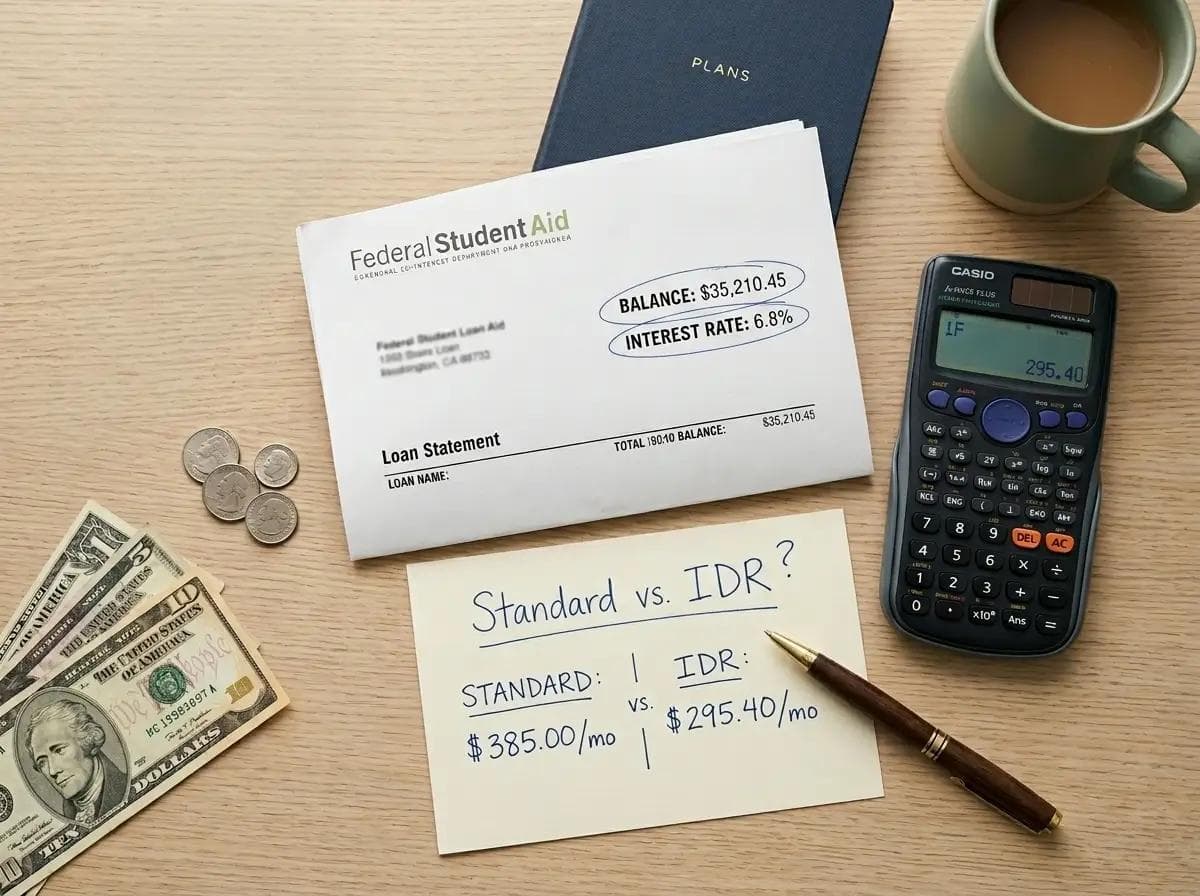
The choice between Standard and income-driven repayment isn't about which plan is objectively better — it's about which fits your income-to-debt ratio. Standard repayment pays off debt fastest and cheapest with fixed payments over 10 years. Income-driven repayment (IDR) ties your monthly payment to what you actually earn, extending forgiveness eligibility at the cost of more total interest. In 2026, the landscape has changed significantly: the One Big Beautiful Bill Act (OBBBA), signed July 4, 2025, introduced two new plans — RAP and the Tiered Standard Plan — reshaping the options available to every federal student loan borrower.
See the difference yourself with our free Student Loan Calculator →
Student Loan Repayment Plans: Side-by-Side Comparison (2026)
| Factor | Standard Plan | Tiered Standard Plan | IBR (Income-Based) | RAP (New 2026) |
|---|---|---|---|---|
| Payment Type | Fixed | Fixed by debt level | Income-based (10–15% discretionary) | Income-based (1–10% of AGI) |
| Repayment Term | 10 years | 10–25 years (by debt level) | 20–25 years | 30 years |
| Minimum Payment | Fixed (loan ÷ 120 + interest) | Fixed by tier | Varies; capped at Standard | $10/month minimum |
| Forgiveness | None (fully paid off) | None (fully paid off) | After 20–25 years | After 30 years |
| Forgiveness Taxable? | N/A | N/A | Yes, beginning 2026 | Yes |
| Dependent Deduction | None | None | None | $50/month per qualifying dependent |
| Interest Subsidy | None | None | None | Yes — unpaid interest subsidy available |
| PSLF Eligible | Yes (120 qualifying payments) | Yes | Yes | Yes |
| Available To | All federal borrowers | All federal borrowers | Pre-July 2026 loans (new IBR closing) | All federal borrowers (July 2026+) |
| Best For | Stable income, minimize total cost | Moderate debt, want fixed payments | Existing borrowers with low income | New borrowers after July 2026 |
| Total Interest Paid | Lowest | Low-moderate | High (20–25 year term) | Highest (30-year term) |
IBR is preserved for existing borrowers on pre-July 2026 loans. RAP becomes the only IDR option for new loans by 2028. SAVE, PAYE, and ICR no longer lead to forgiveness under OBBBA.
What Is a Student Loan Repayment Calculator?
A student loan repayment calculator shows your monthly payment, total interest cost, and payoff date under any repayment plan — letting you compare strategies before choosing one.
Enter your loan balance, interest rate, and loan type, and the calculator projects: monthly payment under each plan, total paid over the repayment term, total interest cost, and forgiveness amount (if applicable). For income-driven plans, you also enter your adjusted gross income and family size, which determine your payment under IBR and RAP.
The calculator's core value is comparison. Most borrowers are eligible for multiple plans. Running them side by side — Standard vs. IBR vs. RAP — reveals the real trade-off: lower monthly payments on IDR always mean more total interest paid and a longer repayment period. Whether that trade-off is worth it depends on your income, debt-to-income ratio, and whether you're pursuing Public Service Loan Forgiveness (PSLF).
What Is the Standard Repayment Plan?
Standard repayment divides your loan into 120 equal fixed payments over 10 years — the fastest path to debt-free and the lowest total interest of any plan.
The formula is straightforward: your monthly payment covers the interest that accrues each month plus enough principal to eliminate the balance in exactly 10 years. Because you pay off the loan in the shortest possible time, you minimize the total interest that accumulates.
Standard repayment is the default plan for borrowers who don't request otherwise. In 2026, a Tiered Standard Plan was also introduced under OBBBA, offering fixed payments across four debt-level tiers:
| Debt Level | Repayment Term |
|---|---|
| Under $25,000 | 10 years |
| $25,000–$49,999 | 15 years |
| $50,000–$99,999 | 20 years |
| $100,000+ | 25 years |
The Tiered Standard Plan produces lower monthly payments for large-debt borrowers than the original Standard Plan, but extends the repayment term and increases total interest. It's a middle ground between Standard and IDR for borrowers who want fixed payments without a 10-year obligation.
Standard is ideal when: your income covers the fixed payment comfortably (typically requiring earnings of at least 1–1.5× your loan balance), you don't qualify for PSLF, and you want to minimize what you pay over the life of your loan.
What Are Income-Driven Repayment Plans in 2026?
IDR plans set your monthly payment as a percentage of your income rather than your loan balance — protecting cash flow when earnings are low relative to debt.
As of June 2026, Federal Student Aid data shows approximately 13 million federal loan borrowers are enrolled in an IDR plan, representing 44% of the repayment population and 62% of all outstanding balances ($784 billion). The landscape shifted significantly on July 4, 2025, when OBBBA restructured the IDR system entirely.
The 2026 IDR landscape:
- check_circleIBR (Income-Based Repayment): Preserved for existing borrowers. Payments are 10% of discretionary income (new borrowers after July 2014) or 15% (earlier borrowers). Forgiveness after 20–25 years. Closed to borrowers taking out new loans after July 1, 2026.
- check_circleRAP (Repayment Assistance Plan): New plan available July 2026 — the only IDR option for new borrowers, and the sole IDR plan by 2028. Payments range from 1–10% of AGI with a $10 floor. Forgiveness after 30 years. Unique features include a $50/month dependent deduction and an interest subsidy for borrowers who can't cover accruing interest.
- check_circlePAYE and ICR: Still available to current enrollees but no longer lead to forgiveness under OBBBA. Only remain worthwhile if they produce the lowest monthly payment.
Which Plan Costs Less Over Time? A Worked Example
Standard repayment always costs less in total interest — but IDR protects monthly cash flow, and forgiveness may offset the difference for high-debt, lower-income borrowers.
Scenario: $45,000 in federal loans at 6.5% interest. Single borrower, $55,000 annual income (AGI).
| Plan | Monthly Payment | Repayment Term | Total Paid | Total Interest | Forgiveness Amount |
|---|---|---|---|---|---|
| Standard | $511 | 10 years | $61,320 | $16,320 | $0 |
| Tiered Standard | $347 | 15 years | $62,460 | $17,460 | $0 |
| IBR (10%) | $229 | 20 years | ~$54,960 + tax | ~$9,960 + forgiven balance | ~$20,000–$30,000 (taxable) |
| RAP | ~$183–$410 | 30 years | Varies by income growth | Highest — 30 yr accrual | Remaining balance (taxable) |
IBR and RAP figures are estimates; actual payments recalculate annually based on income and family size.
Key insight: On this scenario, IBR's total cash outlay is similar to Standard because the forgiven balance carries a tax liability. Standard pays off cleanest. But for a borrower with $100,000+ in loans on $55,000 income — where Standard payments would be over $1,100/month — IDR becomes the only realistic path to staying current.
Model your exact scenario with our free Student Loan Calculator →
When Does Income-Driven Repayment Actually Win?
IDR wins in three specific situations — and in each case, the student loan calculator makes the decision obvious.
Situation 1: High Debt-to-Income Ratio
If your loan balance exceeds your annual income — increasingly common among graduate and professional degree borrowers — Standard payments may consume 20–30% of take-home pay. IDR brings payments to a manageable percentage of income and prevents delinquency, which costs far more in the long run.
Situation 2: Public Service Loan Forgiveness (PSLF)
Borrowers working for qualifying government or nonprofit employers receive forgiveness after 120 qualifying payments (10 years) — and the forgiven amount is not taxable. On IDR, lower monthly payments over 10 years mean less total paid before forgiveness eliminates the remainder. This is the most financially powerful student loan strategy available: Standard payments don't reduce what's forgiven, but they cost more per month.
Situation 3: Income Uncertainty Early in Career
Early-career borrowers in variable-income fields (education, social work, nonprofit, freelance) benefit from IDR's automatic income adjustment. If income drops, your payment drops. If income rises, your payment rises — but never above the Standard plan cap under IBR.
Related Tools & Resources
- check_circleStudent Loan Calculator — Compare Standard, Tiered Standard, IBR, and RAP payments and total costs for your exact balance and income
- check_circleIncome Tax Calculator — Estimate the tax impact of IDR forgiveness or model how student loan interest deductions affect your tax bill
- check_circleBudgeting Tool — Plan your monthly cash flow under whichever repayment plan you choose
- check_circleCredit Card Payoff Calculator — If student loans aren't your only debt, prioritize payoff order by interest rate
Final Thoughts
The right repayment plan is the one that keeps you current, fits your income, and aligns with your 10- and 20-year financial goals. Standard repayment is cleanest and cheapest if your income supports it. IBR protects cash flow and opens PSLF eligibility. RAP — available July 2026 — changes the calculus again for new borrowers with its 30-year term, income-based floor, and interest subsidy.
Run your numbers before you default to whichever plan your servicer assigns. The difference between plans can be tens of thousands of dollars over the life of your loans.
See the difference yourself with our free Student Loan Calculator →
Disclaimer
This blog post is for informational purposes only and does not constitute financial, legal, or tax advice. Student loan repayment rules, plan availability, forgiveness tax treatment, and eligibility requirements are subject to change through legislation, court rulings, and Department of Education policy. The One Big Beautiful Bill Act provisions described reflect the law as signed July 4, 2025 and understood as of June 2026. Verify current plan availability and eligibility at studentaid.gov before enrolling in any repayment plan. Consult a qualified student loan advisor or financial planner for personalized guidance.