The decision to rent or buy isn't one-size-fits-all. In 2026, buying is cheaper in 23 of the 50 largest U.S. metros, while renting costs less in 27, showing how dramatically location affects affordability. For most homebuyers, the key threshold is time: you'll typically need to stay 5–7 years for buying to beat renting financially. Use our free Rent vs. Buy Calculator to find your personal break-even point based on your local home prices, rent costs, and interest rates.
Quick Decision Guide
Choose Renting If:
- check_circleYou plan to move within 3–5 years
- check_circleYou want flexibility and low upfront costs
- check_circleLocal home prices are 20%+ higher than rental equivalents
- check_circleYou prefer to invest money in stocks rather than a down payment
Choose Buying If:
- check_circleYou plan to stay 5–7+ years
- check_circleYou're ready to build equity in an asset
- check_circleYou want a fixed mortgage payment that doesn't increase with inflation
- check_circleYour local market has reasonable price-to-rent ratios
What Is a Rent vs. Buy Calculator?
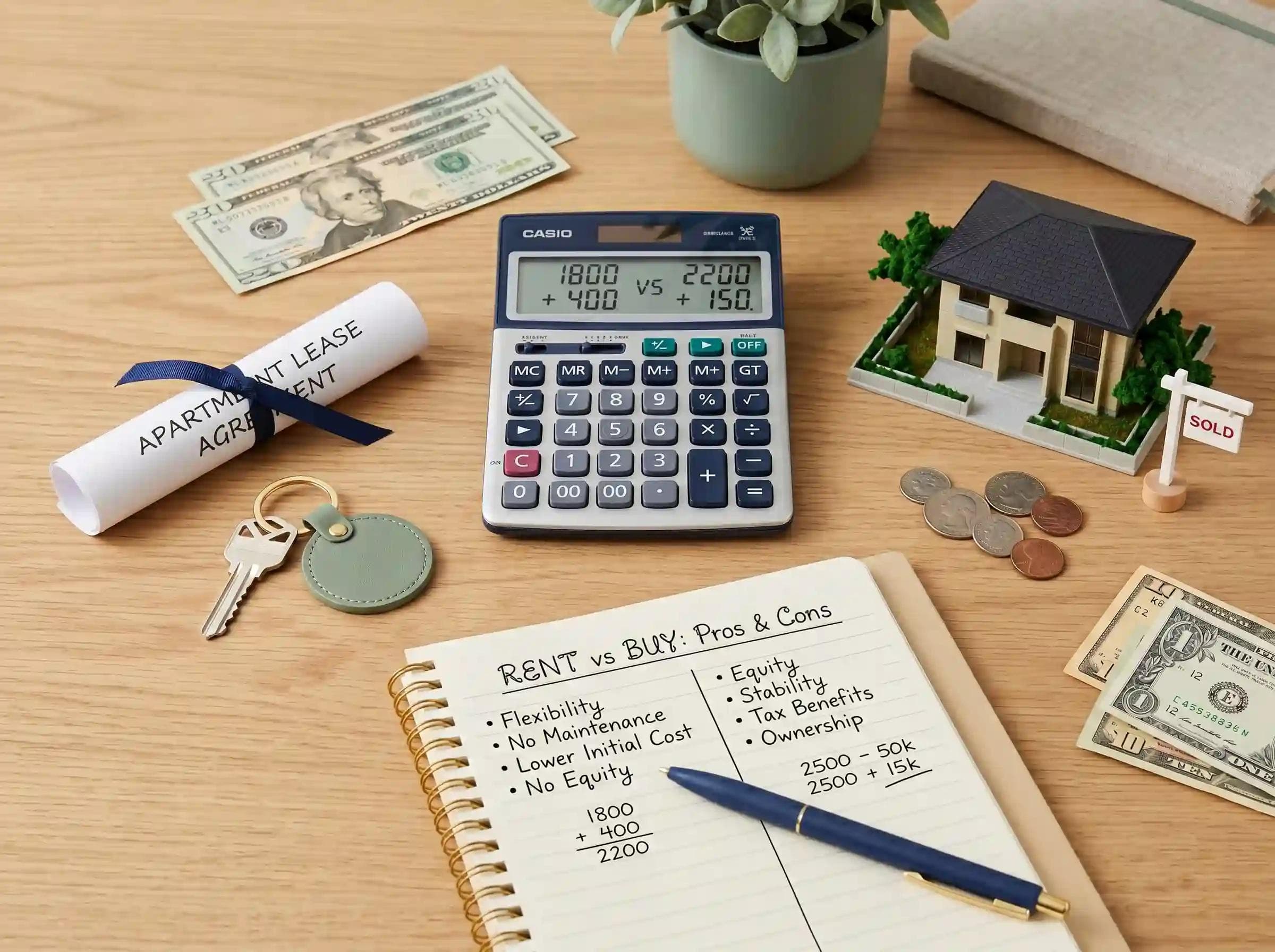
A rent vs. buy calculator instantly compares the total costs of renting versus buying by calculating your break-even point—the number of years you need to stay for buying to become cheaper. Rather than guessing, you input local data and get precise answers about which option saves more money.
Here's what the calculator shows:
- check_circleTotal monthly cost for renting (rent only) vs. buying (mortgage + taxes + insurance + PMI)
- check_circleBreak-even timeframe (typically 5–7 years in most markets)
- check_circleTotal costs over 10 years for each option
- check_circleEquity buildup from homeownership
- check_circleImpact of different scenarios (higher down payment, lower rate, etc.)
The calculator removes emotion from the decision and shows you the real numbers for your situation. In most U.S. markets in 2026, the breakeven horizon is somewhere between five and seven years, though high-cost markets may extend to 10+ years.
Use the Free Rent vs. Buy Calculator Now →
When Should You Rent vs. Buy in 2026?
Short answer: Rent if you'll move soon; buy if you'll stay 5+ years.
Time is the single biggest factor. Below three years, renting almost always wins because you don't recover closing costs, realtor fees, and transaction costs. Between 3–5 years, the decision is close and depends on your local market. Beyond 5–7 years, buying typically builds more wealth through equity growth.
Beyond time, consider:
Location Matters Most
Your zip code determines whether you're in a buyer's or renter's market. As of early 2026, the national median monthly mortgage payment is 20% higher than the median rent, but this varies dramatically by city. Markets in Texas, Florida, and the Midwest often favor buying, while expensive coastal metros favor renting.
Your Financial Readiness
Buying requires capital upfront: down payment (typically 5–20%), closing costs (2–5% of home price), and an emergency fund. For a $400,000 home with 15% down, you need roughly $60,000–$80,000 ready before purchasing.
Renting requires a security deposit and first month's rent—typically $2,000–$4,000—leaving more cash available for investing or other goals.
Life Flexibility
Renting offers flexibility to relocate for jobs, schools, or lifestyle changes without selling a house. Buying locks you into a location and property for years. If your career is uncertain or you might change cities, renting may make sense.
How Do You Calculate Rent vs. Buy?
You compare total housing costs (monthly + upfront) across both options, then see how many years it takes to break even.
The calculation has two parts:
Part 1: Monthly Costs
- check_circleRenting: Rent only ($1,500–$3,000+/month depending on market)
- check_circleBuying: Mortgage payment + property taxes + homeowners insurance + PMI (if applicable) = typically $2,000–$4,500/month
Part 2: Upfront & Long-Term Costs
- check_circleRenting: Security deposit + moving costs (minimal)
- check_circleBuying: Down payment + closing costs + future maintenance (1–2% of home value annually)
Real-World Example
Scenario: $400,000 home in a mid-cost market
| Factor | Renting | Buying |
|---|---|---|
| Monthly payment | $2,200 | $2,650 (mortgage + taxes + insurance) |
| Annual cost | $26,400 | $31,800 |
| Upfront cost | $3,000 (deposit) | $80,000 (20% down + closing) |
| 5-year total | $135,000 | $247,000 |
| BUT equity built | $0 | ~$60,000 |
| Net cost after equity | $135,000 | $187,000 |
| Advantage | ✓ Cheaper short-term | ✓ Building wealth |
At year 7+, the buyer pulls ahead as equity accumulation outpaces the higher monthly cost.
Our calculator automates this entire process for your specific situation—just input your numbers and see the results instantly.
Can You Build Wealth Faster by Renting or Buying?
Buying typically builds more wealth long-term (5+ years), but renting with smart investing can compete if you invest the difference.
Many people assume buying is always the wealth-building winner. That's partially true—homeownership forces discipline through regular mortgage payments and benefits from home appreciation. However, the math is more nuanced.
Buying builds wealth through:
- check_circleMortgage payments building home equity
- check_circleHome appreciation (typically 2–4% annually)
- check_circleLeverage (you control a $400,000 asset with $80,000 down)
Renting + investing can compete if you:
- check_circleInvest your down payment in the stock market
- check_circleInvest the monthly difference between rent and mortgage
- check_circleAchieve market returns (~10% annually, historically)
The winner depends on home price appreciation vs. stock market returns in your holding period. In slower-appreciation markets, smart renters who invest aggressively can match homeowner wealth. In hot real estate markets, buying wins decisively.
Bottom line: If you're disciplined and willing to invest the savings, renting can build wealth. If you prefer passive wealth building, buying forces the discipline through mortgage payments and equity growth.
Rent vs. Buy Comparison Table (2026)
| Factor | Renting | Buying |
|---|---|---|
| Upfront Cost | $2,000–$5,000 | $50,000–$100,000+ |
| Monthly Payment | $1,500–$3,500 | $2,000–$4,500 |
| Flexibility | High (move anytime) | Low (locked in) |
| Maintenance | Landlord covers | You cover (~1–2% annually) |
| Wealth Building | None (payment leaves no equity) | High (equity + appreciation) |
| Break-Even | N/A | 5–7 years (typical) |
| Tax Benefits | None | Mortgage interest deduction |
| Price Risk | Protected (fixed lease) | Exposed (home values fluctuate) |
| Best For | Short-term, flexibility, low capital | Long-term, stability, wealth building |
Related Tools & Resources
Try the Free Rent vs. Buy Calculator Now →
Combine this with our other free tools:
- check_circleMortgage Calculator Guide: Learn how mortgage payments are calculated, understand PMI and interest, and see payment breakdowns
- check_circleAffordability Calculator: Determine your maximum affordable home price based on income and debts
- check_circleMortgage Calculator: Calculate exact monthly payments for different loan scenarios
- check_circleLoan Calculator: Model different down payments and interest rates
Final Thoughts
The rent vs. buy decision isn't about one option being universally "better"—it's about what's right for your timeline, finances, and life situation. Use our free calculator to run the numbers for your specific market and circumstances. The answer typically comes down to one question: How long do you plan to stay?
If it's 5+ years and you have savings for a down payment, buying likely builds more long-term wealth. If it's less than 5 years or you're uncertain, renting preserves flexibility and capital for other investments.
Calculate Your Rent vs. Buy Break-Even Point Now →
Disclaimer
This blog post is for informational purposes only and does not constitute financial, legal, or professional real estate advice. Rent vs. buy decisions depend on individual circumstances, local market conditions, personal preferences, and financial readiness. Consult a qualified financial advisor, real estate agent, or mortgage professional before making homeownership decisions. Rent prices, home values, mortgage rates, and market conditions fluctuate and may differ from estimates provided. Past performance and historical returns do not guarantee future results.