What Is the Percentage Formula?
The basic percentage formula is:
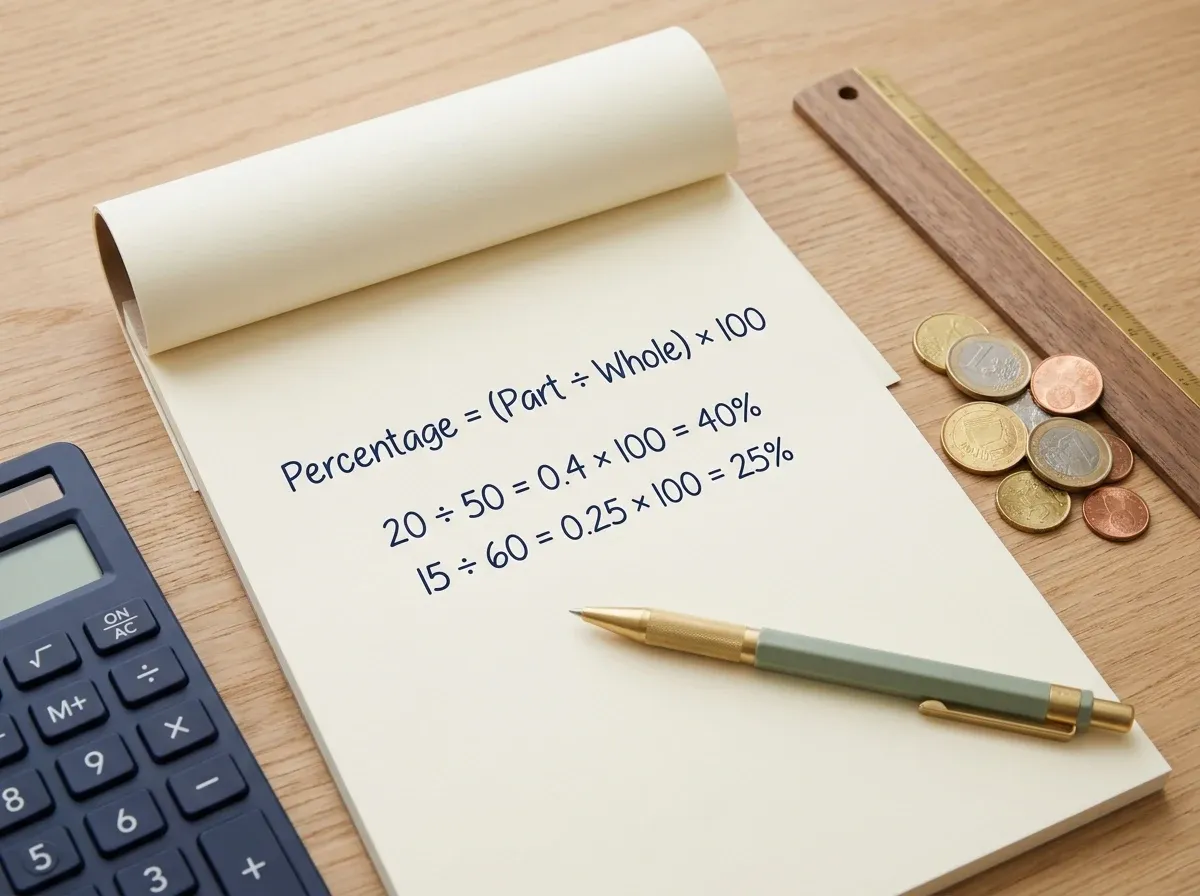
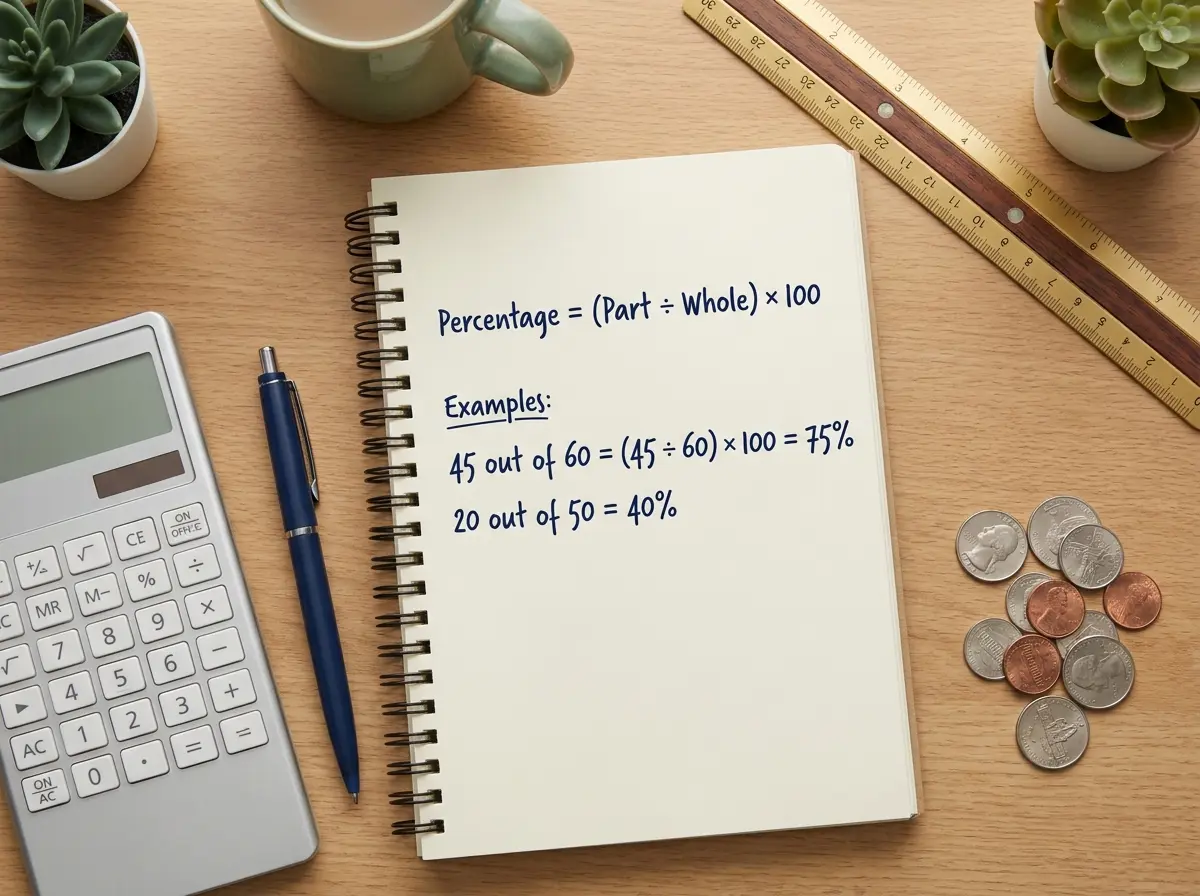
Percentage = (Part ÷ Whole) × 100
A percentage expresses a value as a part of 100. For example, if 25 out of 50 students pass an exam, the percentage is:
(25 ÷ 50) × 100 = 50%
So, 25 is 50% of 50.
The same basic formula can be used for marks, survey results, sales figures, test scores, and many everyday calculations. Other percentage problems, such as increases, decreases, differences, and errors, use variations of this formula.
Basic Percentage Formula
The basic percentage formula is:
Percentage = (Part ÷ Whole) × 100
The three values have different roles:
- check_circlePart: The amount being compared.
- check_circleWhole: The total amount or reference value.
- check_circle100: Converts the decimal result into a percentage.
Example
Suppose a student gets 36 correct answers out of 40 questions.
- check_circlePart = 36
- check_circleWhole = 40
Apply the formula:
Percentage = (36 ÷ 40) × 100
Percentage = 0.9 × 100
Percentage = 90%
The student's score is 90%.
Percentage Formula Explained With Examples
Understanding how the formula works is easier when you apply it to different situations.
Example 1: What Percentage Is 20 of 80?
Use:
Percentage = (Part ÷ Whole) × 100
Substitute the values:
Percentage = (20 ÷ 80) × 100
= 0.25 × 100
= 25%
Therefore, 20 is 25% of 80.
Example 2: What Percentage Is 45 of 60?
Percentage = (45 ÷ 60) × 100
= 0.75 × 100
= 75%
Therefore, 45 is 75% of 60.
Example 3: What Percentage Is 15 of 25?
Percentage = (15 ÷ 25) × 100
= 0.6 × 100
= 60%
Therefore, 15 is 60% of 25.
Percentage Formula for a Number
The formula changes slightly when you already know the percentage and want to find the corresponding amount.
The percentage of a number formula is:
Amount = (Percentage ÷ 100) × Number
For example, to find 30% of 200:
Amount = (30 ÷ 100) × 200
= 0.30 × 200
= 60
Therefore, 30% of 200 is 60.
This is sometimes described as the percentage formula of a number because it tells you how much a given percentage represents from a specific number.
More Examples
| Problem | Calculation | Answer |
|---|---|---|
| 10% of 500 | (10 ÷ 100) × 500 | 50 |
| 20% of 150 | (20 ÷ 100) × 150 | 30 |
| 25% of 400 | (25 ÷ 100) × 400 | 100 |
| 40% of 250 | (40 ÷ 100) × 250 | 100 |
| 75% of 80 | (75 ÷ 100) × 80 | 60 |
How to Calculate Percentage Using the Formula
For a basic percentage calculation, follow these three steps:
- Identify the part.
- Identify the whole.
- Divide the part by the whole and multiply by 100.
Example
A shop sold 72 items out of 90 available items. What percentage were sold?
Step 1: Identify the part
72 items were sold.
Step 2: Identify the whole
There were 90 items.
Step 3: Apply the formula
Percentage = (72 ÷ 90) × 100
= 80%
So, the shop sold 80% of its items.
Percentage Formula for Marks
To calculate a percentage from marks, divide the marks obtained by the total marks and multiply by 100.
The percentage formula for marks is:
Percentage = (Marks Obtained ÷ Total Marks) × 100
Example: 450 Out of 500 Marks
Suppose a student scores 450 marks out of 500.
Percentage = (450 ÷ 500) × 100
= 0.9 × 100
= 90%
The student's percentage is 90%.
Example: 720 Out of 900 Marks
Percentage = (720 ÷ 900) × 100
= 0.8 × 100
= 80%
The percentage is 80%.
The formula works regardless of the total marks, as long as the marks obtained and total marks use the same scale.
Percentage Formula for Discount
A percentage discount tells you how much is deducted from an original price.
First calculate the discount amount:
Discount = (Discount Percentage ÷ 100) × Original Price
Then subtract the discount from the original price:
Final Price = Original Price − Discount
Example: 25% Discount on $120
Calculate the discount:
Discount = (25 ÷ 100) × $120
= $30
Now subtract it:
Final Price = $120 − $30
= $90
The discounted price is $90.
You can also calculate the final price directly:
Final Price = Original Price × (1 − Discount Percentage ÷ 100)
For this example:
$120 × (1 − 25 ÷ 100) = $90
Percentage Increase Formula
The percentage increase formula measures how much a value has increased compared with its original value.
Percentage Increase = ((New Value − Original Value) ÷ Original Value) × 100
Example
A product's price increases from $80 to $100.
First find the increase:
$100 − $80 = $20
Then apply the formula:
Percentage Increase = ($20 ÷ $80) × 100
= 25%
The price increased by 25%.
For a quick calculation, use a percentage increase calculator.
Percentage Decrease Formula
The percentage decrease formula measures how much a value has fallen compared with its original value.
Percentage Decrease = ((Original Value − New Value) ÷ Original Value) × 100
Example
A product's price falls from $200 to $150.
First find the decrease:
$200 − $150 = $50
Then:
Percentage Decrease = ($50 ÷ $200) × 100
= 25%
The price decreased by 25%.
You can use a percentage decrease calculator for faster calculations.
Percentage Change Formula
The percentage change formula is commonly used to compare an original value with a new value.
Percentage Change = ((New Value − Original Value) ÷ Original Value) × 100
Example
A website received 2,000 visitors last month and 2,500 this month.
Percentage Change = ((2,500 − 2,000) ÷ 2,000) × 100
= (500 ÷ 2,000) × 100
= 25%
The number of visitors increased by 25%.
For dedicated calculations, use the percentage change calculator.
Percentage Difference Formula
Percentage difference is useful when comparing two values without treating either one as the original or reference value.
The formula is:
Percentage Difference = (|Value 1 − Value 2| ÷ ((Value 1 + Value 2) ÷ 2)) × 100
The absolute difference is divided by the average of the two values.
Example
Suppose two measurements are 80 and 100.
First find their difference:
|80 − 100| = 20
Then find their average:
(80 + 100) ÷ 2 = 90
Now calculate:
Percentage Difference = (20 ÷ 90) × 100
≈ 22.22%
The percentage difference is approximately 22.22%.
This calculation is different from percentage increase or decrease because neither value is automatically treated as the starting value.
Percentage Error Formula
Percentage error compares an experimental or measured value with an accepted or true value.
A common formula is:
Percentage Error = (|Experimental Value − True Value| ÷ |True Value|) × 100
Example
Suppose the accepted value is 50 and the measured value is 48.
Percentage Error = (|48 − 50| ÷ 50) × 100
= (2 ÷ 50) × 100
= 4%
The percentage error is 4%.
For scientific or laboratory work, make sure you use the definition and reference value required by your course, field, or institution.
Common Percentage Formula Mistakes
Dividing by the Wrong Number
For a basic percentage, the part is divided by the whole.
For example, if 30 is what percentage of 120:
(30 ÷ 120) × 100 = 25%
Reversing the numbers gives a completely different result.
Forgetting to Multiply by 100
If:
30 ÷ 120 = 0.25
The result is a decimal, not yet a percentage.
Convert it to a percentage:
0.25 × 100 = 25%
Using the New Value Instead of the Original Value
For percentage increase and decrease, the original value is normally the reference point.
If a price increases from $100 to $120:
((120 − 100) ÷ 100) × 100 = 20%
The denominator is the original $100, not the new $120.
Confusing a Percentage With a Percentage Point
Suppose a pass rate increases from 60% to 70%.
The difference is 10 percentage points.
The relative percentage increase is:
((70 − 60) ÷ 60) × 100 = 16.67%
These describe two different things, so they should not be used interchangeably.
Quick Reference: Percentage Formulas
| Calculation | Formula |
|---|---|
| Basic percentage | (Part ÷ Whole) × 100 |
| Percentage of a number | (Percentage ÷ 100) × Number |
| Percentage increase | ((New − Original) ÷ Original) × 100 |
| Percentage decrease | ((Original − New) ÷ Original) × 100 |
| Percentage change | ((New − Original) ÷ Original) × 100 |
| Percentage difference | (Absolute Difference ÷ Average) × 100 |
| Percentage error | (Absolute Error ÷ True Value) × 100 |
The right formula depends on what you are trying to find. Identifying the purpose of the calculation before entering the numbers helps prevent mistakes.