What Is a Percentage?
A percentage is a way of expressing a number as a fraction of 100. The word "percent" means "per hundred," so 25% means 25 out of 100, or 25/100.
Percentages are used in everyday calculations, including exam marks, discounts, price changes, business reports, statistics, and financial calculations.
The basic percentage formula is:
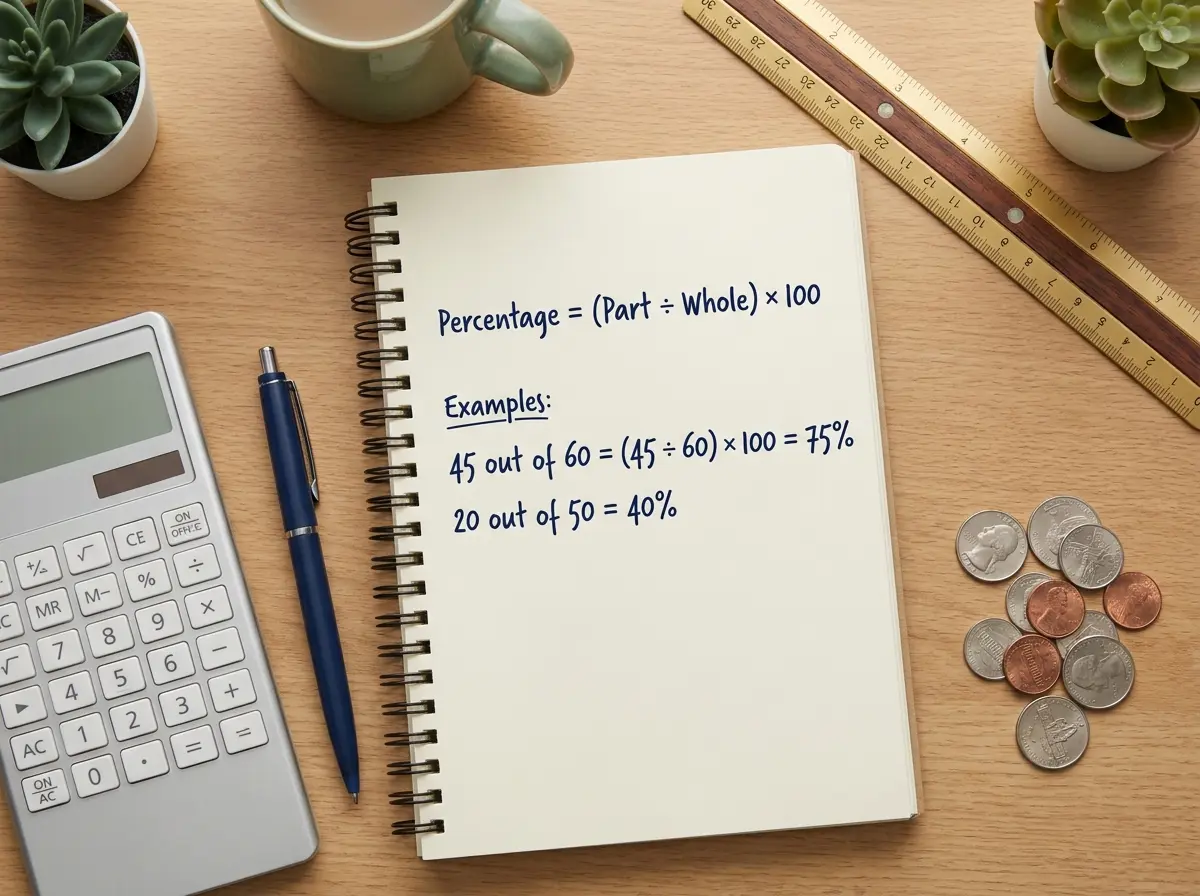
Percentage = (Part ÷ Whole) × 100
For example, if you scored 45 marks out of 60:
Percentage = (45 ÷ 60) × 100 = 75%
So, your score is 75%.
If you need to calculate a percentage quickly, you can also use a percentage calculator.
Percentage Formula
The basic percentage formula is:
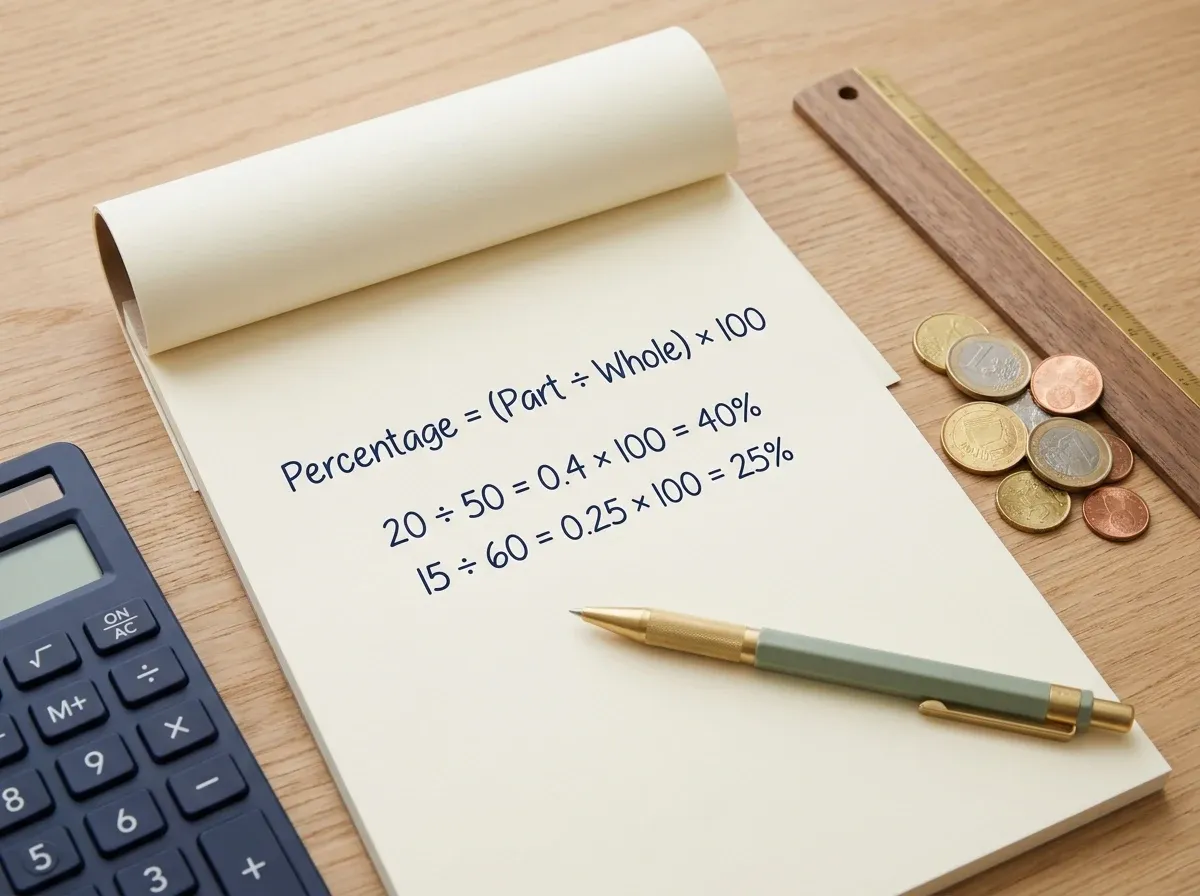
Percentage = (Part ÷ Whole) × 100
Where:
- check_circlePart is the amount you are comparing.
- check_circleWhole is the total amount.
- check_circle100 converts the result into a percentage.
For example, suppose a class has 40 students and 28 passed an exam.
Percentage = (28 ÷ 40) × 100
Percentage = 0.7 × 100
Percentage = 70%
Therefore, 70% of the students passed.
Percentage Calculation Formula
Different percentage problems use slightly different versions of the basic formula.
| What you want to find | Formula |
|---|---|
| Percentage | (Part ÷ Whole) × 100 |
| Percentage of a number | (Percentage ÷ 100) × Number |
| Original number | Part ÷ (Percentage ÷ 100) |
| Percentage increase | ((New − Original) ÷ Original) × 100 |
| Percentage decrease | ((Original − New) ÷ Original) × 100 |
| Percentage change | ((New − Original) ÷ Original) × 100 |
Understanding which numbers represent the part, whole, original value, and new value is the key to choosing the correct formula.
How to Calculate a Percentage
To calculate a percentage, divide the part by the whole and multiply the result by 100.
Step 1: Identify the part and whole
Suppose you answered 36 questions correctly out of 50.
- check_circlePart = 36
- check_circleWhole = 50
Step 2: Divide the part by the whole
36 ÷ 50 = 0.72
Step 3: Multiply by 100
0.72 × 100 = 72
Therefore:
36 out of 50 = 72%
This method works for many everyday percentage calculations.
How to Calculate a Percentage of a Number
To calculate a percentage of a number, convert the percentage to a decimal and multiply it by the number.
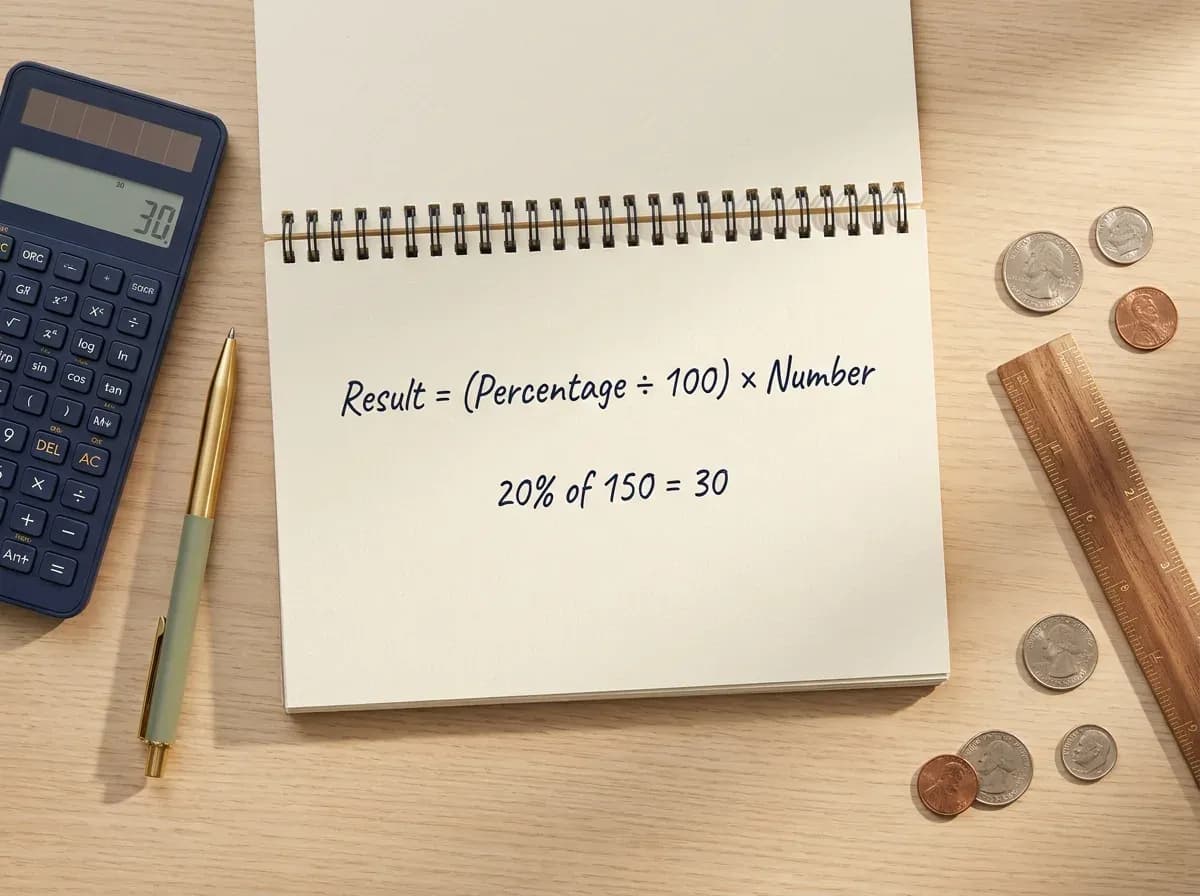
The percentage of a number formula is:
Percentage of a number = (Percentage ÷ 100) × Number
Example: Calculate 20% of 150
Convert 20% to a decimal:
20 ÷ 100 = 0.20
Then multiply:
0.20 × 150 = 30
So, 20% of 150 is 30.
How to Calculate 10% of a Number
To calculate 10% of a number, multiply the number by 0.10.
For example:
10% of 80 = 0.10 × 80 = 8
So, 10% of 80 is 8.
How to Calculate 20% of a Number
For example, to calculate 20% of 250:
20% of 250 = 0.20 × 250
= 50
Therefore, 20% of 250 is 50.
How to Calculate 25% of a Number
Since 25% is one-quarter, you can divide the number by 4.
For example:
25% of 200 = 200 ÷ 4 = 50
Therefore, 25% of 200 is 50.
How to Find What Percentage One Number Is of Another
If you want to know what percentage one number represents of another, divide the first number by the second and multiply by 100.
The formula is:
Percentage = (First Number ÷ Second Number) × 100
Example
What percentage is 30 of 120?
Percentage = (30 ÷ 120) × 100
= 0.25 × 100
= 25%
Therefore, 30 is 25% of 120.
This answers questions such as:
- check_circleWhat percentage is 15 of 60?
- check_circleWhat percentage is 45 of 90?
- check_circleWhat percentage is 80 of 200?
- check_circleHow do I find what percentage one number is of another?
Another Example
Suppose you have 18 apples and 6 are green. What percentage of the apples are green?
Percentage = (6 ÷ 18) × 100
= 33.33%
So, approximately 33.33% of the apples are green.
How to Calculate Percentage From Marks
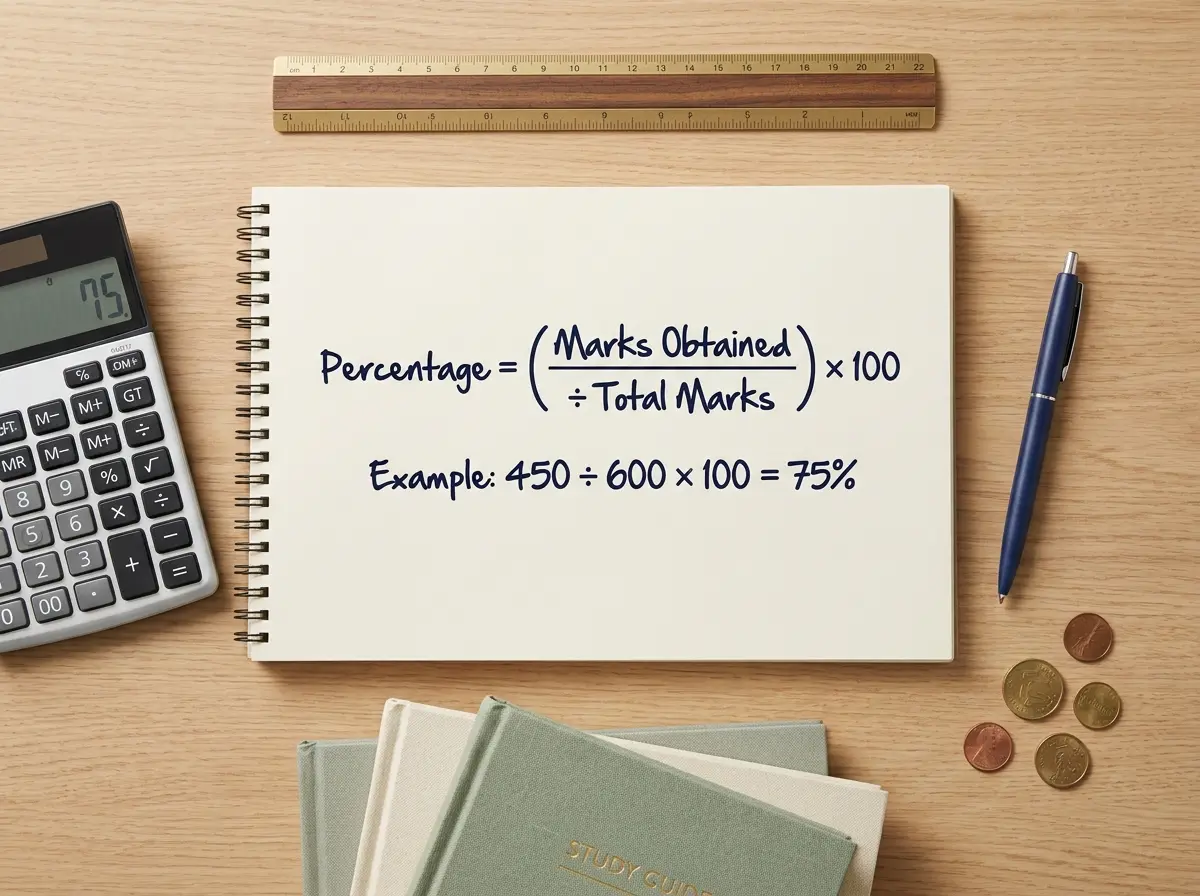
To calculate your percentage from marks, divide the marks you obtained by the total marks and multiply by 100.
The formula is:
Percentage = (Marks Obtained ÷ Total Marks) × 100
Example: 450 Out of 600 Marks
Suppose a student gets 450 marks out of 600.
Percentage = (450 ÷ 600) × 100
= 0.75 × 100
= 75%
The student's percentage is 75%.
Example: 720 Out of 900 Marks
Percentage = (720 ÷ 900) × 100
= 80%
Therefore, the student scored 80%.
The same calculation can be used for individual subjects or an entire examination, provided you are using the correct total marks.
How to Calculate Percentage Discount
A percentage discount tells you how much is being reduced from the original price.
First, calculate the discount amount:
Discount = (Discount Percentage ÷ 100) × Original Price
Then subtract the discount from the original price:
Final Price = Original Price − Discount
Example: 20% Discount on $80
Calculate the discount:
20% of $80 = 0.20 × 80 = $16
Subtract the discount:
$80 − $16 = $64
So, the final price is $64.
Quick Way to Calculate a Discounted Price
You can also calculate the final price directly:
Final Price = Original Price × (1 − Discount ÷ 100)
For a 20% discount:
$80 × (1 − 20 ÷ 100)
= $80 × 0.80
= $64
How to Calculate Percentage Increase
A percentage increase shows how much a value has increased relative to its original value.
The percentage increase formula is:
Percentage Increase = ((New Value − Original Value) ÷ Original Value) × 100
Example
A product's price increases from $50 to $65.
First find the increase:
$65 − $50 = $15
Then divide by the original price:
$15 ÷ $50 = 0.30
Multiply by 100:
0.30 × 100 = 30%
The price increased by 30%.
For repeated or more detailed calculations, use a percentage increase calculator.
How to Calculate Percentage Decrease
A percentage decrease shows how much a value has fallen compared with its original value.
The percentage decrease formula is:
Percentage Decrease = ((Original Value − New Value) ÷ Original Value) × 100
Example
A price decreases from $200 to $150.
First calculate the decrease:
$200 − $150 = $50
Then divide by the original price:
$50 ÷ $200 = 0.25
Multiply by 100:
0.25 × 100 = 25%
The price decreased by 25%.
You can use a percentage decrease calculator when you need to perform this calculation quickly.
How to Calculate Percentage Change
Percentage change is used to compare an old value with a new value.
The standard percentage change formula is:
Percentage Change = ((New Value − Original Value) ÷ Original Value) × 100
Example
A website receives 800 visitors one month and 1,000 the next month.
Percentage Change = ((1,000 − 800) ÷ 800) × 100
= (200 ÷ 800) × 100
= 25%
The number of visitors increased by 25%.
For more detailed calculations, see the percentage change calculator.
Percentage Increase vs. Percentage Decrease
Although both calculations compare an old value with a new value, the direction of the change determines which formula you use.
| Calculation | Formula |
|---|---|
| Increase | ((New − Original) ÷ Original) × 100 |
| Decrease | ((Original − New) ÷ Original) × 100 |
For example, if a price rises from $100 to $120, the increase is:
((120 − 100) ÷ 100) × 100 = 20%
If it falls from $100 to $80, the decrease is:
((100 − 80) ÷ 100) × 100 = 20%
The original value is used as the reference point in both calculations.
Common Percentage Calculation Mistakes
Percentage problems are usually straightforward, but a few mistakes can lead to incorrect results.
Using the wrong whole
When finding what percentage one number is of another, make sure the number after "of" is the whole or reference value.
For example:
30 is what percentage of 120?
The correct calculation is:
(30 ÷ 120) × 100 = 25%
Not:
(120 ÷ 30) × 100
Forgetting to multiply by 100
If you calculate:
30 ÷ 120 = 0.25
That is the decimal form. To express it as a percentage:
0.25 × 100 = 25%
Confusing percentage points with percentage change
A change from 40% to 50% is an increase of 10 percentage points.
The percentage increase relative to 40% is:
((50 − 40) ÷ 40) × 100 = 25%
So, 40% to 50% is a 10-percentage-point increase, but a 25% increase relative to the original percentage.
How to Calculate Percentage on a Calculator
You can calculate a percentage using a basic calculator by following the formula that matches your problem.
For a basic percentage:
- Enter the part.
- Divide by the whole.
- Multiply by 100.
- Add the percentage sign to the result.
For example:
45 ÷ 60 × 100 = 75%
For a percentage of a number:
20 ÷ 100 × 150 = 30
You can also use an online percentage calculator if you want to avoid doing the calculation manually.
A Simple Way to Remember the Percentage Formula
For basic percentage problems, remember:
Part ÷ Whole × 100
Think of the question as:
"The part is what fraction of the whole?"
For example, if 15 out of 20 questions are correct:
15 ÷ 20 × 100 = 75%
Once you identify the part and the whole correctly, the percentage calculation becomes much easier.