How to Calculate Exam Percentage
To calculate your exam percentage, divide the marks obtained by the total marks and multiply the result by 100.
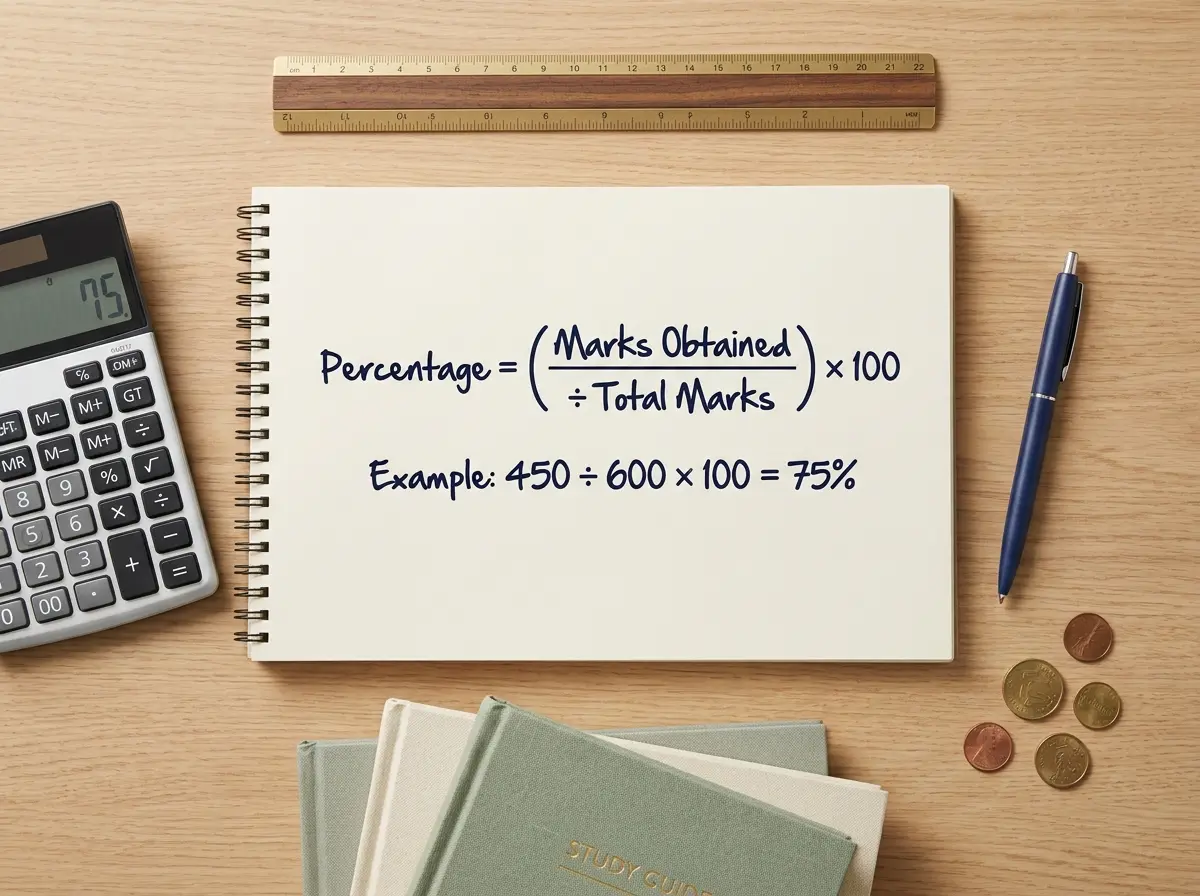
Exam Percentage = (Marks Obtained ÷ Total Marks) × 100
For example, if you scored 420 marks out of 500:
(420 ÷ 500) × 100 = 84%
Your exam percentage is 84%.
If you want to calculate your result quickly, use a percentage calculator.
Exam Percentage Formula
The basic percentage of marks formula is:
Percentage = (Marks Obtained ÷ Total Marks) × 100
- check_circleMarks Obtained: The marks you actually scored.
- check_circleTotal Marks: The maximum marks available.
- check_circle100: Converts the result into a percentage.
Example
Suppose an exam is worth 800 marks and you obtained 640.
Percentage = (640 ÷ 800) × 100
= 80%
So, your exam percentage is 80%.
Learn more about the percentage formula and its different uses.
How to Calculate Percentage of Marks
To calculate percentage of marks:
- Add or identify your marks obtained.
- Find the total or maximum marks.
- Divide marks obtained by total marks.
- Multiply by 100.
Example: 80 Marks Out of 100
Percentage = (80 ÷ 100) × 100 = 80%
Therefore, 80 marks out of 100 is 80%.
Example: 450 Marks
Suppose you obtained 450 marks out of 600.
Percentage = (450 ÷ 600) × 100 = 75%
Therefore, 450 marks out of 600 is 75%.
The number 450 alone does not tell you the percentage. You also need the total marks.
Learn how to calculate percentage with simple examples.
How to Calculate Percentage in Exams With Multiple Subjects
For several subjects, add the marks obtained in all subjects and add the maximum marks for those same subjects.
Overall Percentage = (Total Marks Obtained ÷ Total Maximum Marks) × 100
Do not simply add individual subject percentages. If subjects have different maximum marks, that can give an incorrect overall result.
Learn how to find the percentage of a number with easy examples.
How to Calculate Percentage of 5 Subjects
Suppose you have five subjects, each worth 100 marks:
| Subject | Marks Obtained | Maximum Marks |
|---|---|---|
| English | 78 | 100 |
| Mathematics | 85 | 100 |
| Physics | 72 | 100 |
| Chemistry | 81 | 100 |
| Biology | 84 | 100 |
| Total | 400 | 500 |
Percentage = (400 ÷ 500) × 100 = 80%
The overall percentage is 80%.
How to Calculate Percentage From 6 Subjects
Suppose your marks are:
- check_circleEnglish: 75
- check_circleMathematics: 82
- check_circlePhysics: 68
- check_circleChemistry: 79
- check_circleBiology: 86
- check_circleComputer Science: 90
Total marks obtained:
75 + 82 + 68 + 79 + 86 + 90 = 480
Maximum marks:
6 × 100 = 600
Therefore:
Percentage = (480 ÷ 600) × 100 = 80%
Your overall percentage is 80%.
What If Subjects Have Different Total Marks?
If subjects have different maximum marks, add the marks obtained and maximum marks separately.
| Subject | Marks Obtained | Maximum Marks |
|---|---|---|
| Mathematics | 72 | 100 |
| English | 84 | 100 |
| Science | 135 | 150 |
| History | 76 | 100 |
| Total | 367 | 450 |
Percentage = (367 ÷ 450) × 100 ≈ 81.56%
The overall percentage is approximately 81.56%.
How to Find Exam Percentage From Marks
If you already know your marks obtained and total marks, use:
Percentage = (Marks Obtained ÷ Total Marks) × 100
For example:
Marks obtained = 525
Total marks = 750
Percentage = (525 ÷ 750) × 100 = 70%
So, the exam percentage is 70%.
Quick Examples
| Marks Obtained | Total Marks | Percentage |
|---|---|---|
| 80 | 100 | 80% |
| 90 | 100 | 90% |
| 360 | 400 | 90% |
| 450 | 600 | 75% |
| 525 | 750 | 70% |
| 720 | 900 | 80% |
| 850 | 1,000 | 85% |
How to Calculate Percentage on a Calculator
Enter:
Marks Obtained ÷ Total Marks × 100
For 450 marks out of 600:
450 ÷ 600 × 100 = 75%
For multiple subjects, add the marks obtained first and then add the maximum marks before applying the formula.
You can also use an exam percentage calculator to calculate the result quickly.
Common Mistakes When Calculating Exam Percentage
Using the Wrong Total Marks
The denominator should be the total marks used for the calculation.
If you scored 360 out of 450:
(360 ÷ 450) × 100 = 80%
Adding Percentages Instead of Marks
For several subjects, add the marks obtained and maximum marks rather than simply adding subject percentages.
Including Subjects That Should Not Count
Some examination systems use a particular combination of subjects to determine the final percentage. Check the relevant examination rules before calculating an official result.
Confusing Percentage With Marks
80 marks is not automatically 80%.
- check_circle80 out of 100 = 80%
- check_circle80 out of 200 = 40%
- check_circle80 out of 400 = 20%
The total marks determine the percentage.
Related Percentage Calculations
Percentage Increase
If you compare an exam score with a previous score, you may need the percentage increase formula.
Percentage Increase = ((New Value − Original Value) ÷ Original Value) × 100
For example, a score rising from 60 to 75:
((75 − 60) ÷ 60) × 100 = 25%
Use a percentage increase calculator for quick calculations.
Percentage Decrease
If an exam score falls from 80 to 68:
Percentage Decrease = ((Original Value − New Value) ÷ Original Value) × 100
= ((80 − 68) ÷ 80) × 100 = 15%
Use a percentage decrease calculator when needed.
Percentage Change
Percentage Change = ((New Value − Original Value) ÷ Original Value) × 100
A score changing from 70 to 84 represents:
((84 − 70) ÷ 70) × 100 = 20%
Use a percentage change calculator for this calculation.
Percentage Difference
Percentage difference is used when comparing two values without treating either as the original value.
Percentage Difference = (|Value 1 − Value 2| ÷ ((Value 1 + Value 2) ÷ 2)) × 100
For scores of 70 and 80:
(10 ÷ 75) × 100 ≈ 13.33%
Use a percentage difference calculator when comparing two values.
Percentage Error
A common percentage error formula is:
Percentage Error = (|Measured Value − True Value| ÷ |True Value|) × 100
If the measured value is 96 and the accepted value is 100:
(|96 − 100| ÷ 100) × 100 = 4%
Use a percentage error calculator for this type of calculation.
APUSH Exam Calculations
If you are preparing for the AP U.S. History exam, an APUSH calculator can help estimate your exam score based on the relevant scoring components.
APUSH scoring is different from a simple marks-percentage calculation, so use the appropriate APUSH scoring method rather than treating the entire exam as a standard percentage.
Understanding Your Exam Percentage
Your percentage shows how many marks you earned compared with the maximum marks available.
- check_circle90% means 90 marks for every 100 available.
- check_circle75% means 75 marks for every 100 available.
- check_circle60% means 60 marks for every 100 available.
- check_circle50% means half of the available marks.
A percentage puts exam scores on a common 0–100 scale, making scores from exams with different total marks easier to compare.
A Simple Way to Remember the Exam Percentage Formula
Remember:
Marks Obtained ÷ Total Marks × 100
For multiple subjects:
Total Marks Obtained ÷ Total Maximum Marks × 100
For example:
720 ÷ 900 × 100 = 80%
The key is to identify the correct marks obtained and total marks before calculating.