Americans carry $1.252 trillion in credit card debt as of Q1 2026, with the average APR sitting at 21.52% for cards actively accruing interest, according to LendingTree's analysis of Federal Reserve Bank of New York data. At that rate, paying only the minimum on the average $6,523 balance takes 170 months — over 14 years — and costs $6,491 in interest: nearly the same as the original balance. A credit card payoff calculator changes that equation in seconds by showing you exactly how much to pay, by when, and which method eliminates debt fastest.
Calculate your credit card payoff with our free Credit Card Payoff Calculator →
Payoff Method Quick-Reference
The fastest method depends on your goal: minimum total interest saved (avalanche) or fastest motivational win (snowball).
| Method | How It Works | Best For | Interest Saved vs. Minimum |
|---|---|---|---|
| Minimum payment only | Pay 2–3% of balance monthly | Nobody — costs the most | Baseline (worst outcome) |
| Fixed extra payment | Add set amount above minimum | Predictable budgets | Moderate |
| Debt avalanche | Attack highest-APR card first | Minimizing total interest | Maximum savings |
| Debt snowball | Attack lowest-balance card first | Building momentum, motivation | Slightly less than avalanche |
| Balance transfer (0% APR) | Move balance to 0% intro card | Good credit; high-APR balances | Eliminates interest during intro period |
| Personal loan consolidation | Replace cards with fixed-rate loan | Multiple cards; stable income | Depends on loan rate vs. card APR |
What Is a Credit Card Payoff Calculator?
A credit card payoff calculator shows you exactly how long it will take to pay off your balance — and how much interest you'll pay — under any payment scenario you choose.
Enter your balance, APR, and monthly payment, and the calculator outputs: your payoff date, total interest paid, and month-by-month amortization. Change the monthly payment and every figure updates instantly. This gives you the precise answer to the most important debt question: "How much do I need to pay each month to be debt-free by [date]?"
Most credit card statements only show the minimum payment — an amount deliberately calibrated to extend repayment as long as possible. A payoff calculator shows what the statement doesn't: what happens when you pay $50, $100, or $200 more per month, and how dramatically that changes both your payoff date and total interest cost.
How Does Credit Card Interest Actually Work?
Credit card interest compounds daily — meaning every day you carry a balance, you're charged interest on the balance plus all interest already accumulated.
Here's the math behind it:
Daily Periodic Rate = Annual APR ÷ 365
At 21.52% APR, your daily rate is 0.059%. On a $5,000 balance, that's $2.95 in interest added every single day — $88.50 per month before you make a single payment.
This is why minimum payments are so destructive. Minimum payments on a typical card are 2–3% of the balance. On $5,000 at 21.52% APR, your minimum payment might be $100. But $88.50 of that goes straight to interest, leaving only $11.50 to reduce the actual balance. At that rate, the balance barely moves — and next month, you pay nearly the same amount in interest on nearly the same balance.
The minimum payment trap in real dollars:
| Balance | APR | Monthly Minimum | Months to Pay Off | Total Interest Paid |
|---|---|---|---|---|
| $3,000 | 21.52% | ~$60 | 94 months (7.8 yrs) | $2,573 |
| $5,000 | 21.52% | ~$100 | 110 months (9.2 yrs) | $4,442 |
| $10,000 | 21.52% | ~$200 | 128 months (10.7 yrs) | $9,148 |
Assumes minimum payment = 2% of balance, declines as balance drops.
What's the Fastest Way to Pay Off Credit Card Debt?
Pay as much above the minimum as your budget allows, starting with the highest-APR card first — the debt avalanche method.
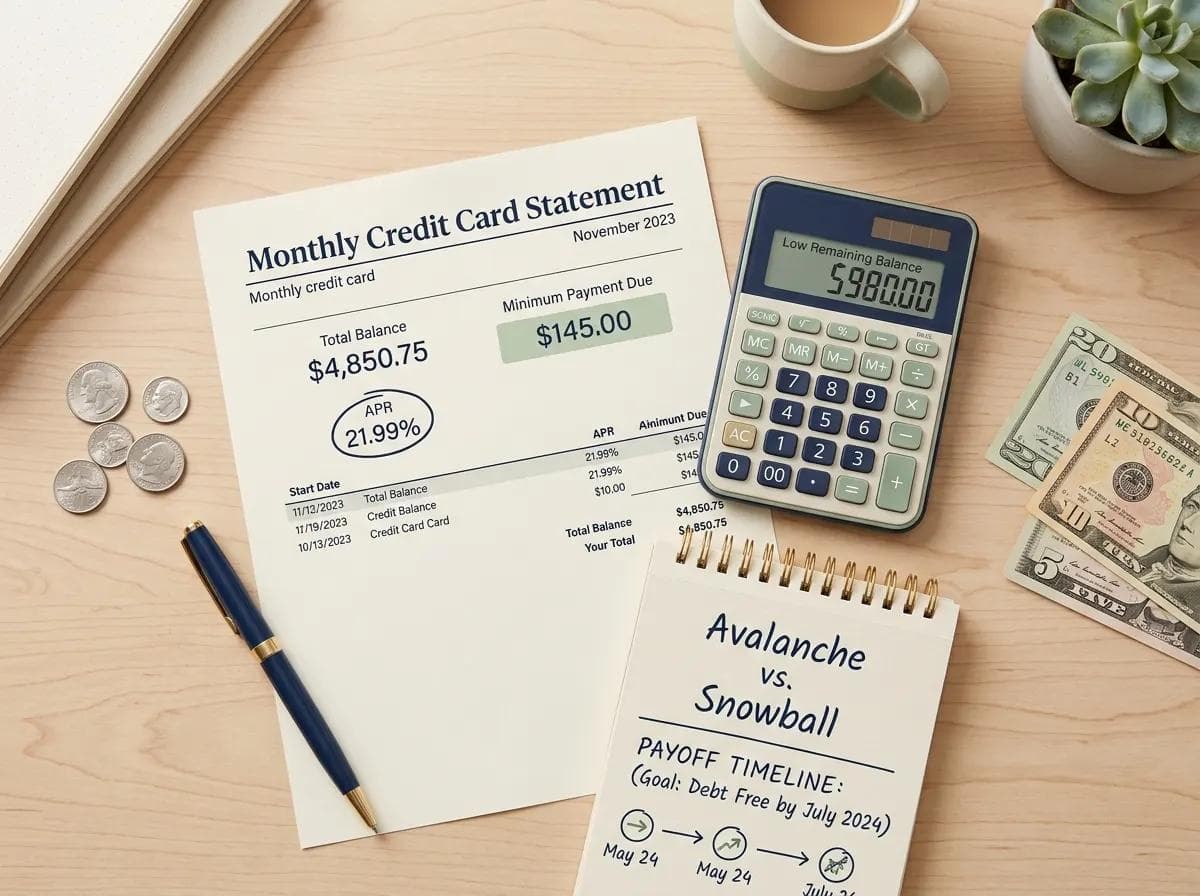
The avalanche method eliminates credit card debt at the lowest possible total cost by attacking the card charging you the most interest per dollar of balance. While the snowball method (smallest balance first) creates faster psychological wins by closing accounts sooner, the avalanche saves more money over the full payoff period.
Here's how a $15,000 debt across three cards plays out under each method:
Portfolio: Card A — $6,000 at 24% APR | Card B — $5,000 at 19% APR | Card C — $4,000 at 15% APR Total monthly payment available: $500
| Method | Order of Attack | Total Interest Paid | Months to Debt-Free |
|---|---|---|---|
| Minimum only | No priority | ~$14,200 | 180+ months |
| Snowball | Card C → B → A (smallest first) | ~$4,800 | 38 months |
| Avalanche | Card A → B → C (highest APR first) | ~$4,100 | 38 months |
Same months to debt-free. Same monthly payment. But the avalanche saves ~$700 more in interest on this portfolio. On larger balances or higher APR spreads, the difference grows significantly.
Run your own avalanche or snowball scenario →
Debt Snowball vs. Debt Avalanche: Which Should You Use?
Use the avalanche if you're motivated by numbers. Use the snowball if you need early wins to stay on track.
The academic answer is the avalanche — it costs less. But debt payoff is as much a psychology problem as a math problem. Research consistently finds that people who eliminate small balances quickly (snowball) maintain higher motivation and lower dropout rates — especially early in a debt payoff journey when the finish line feels distant.
A practical hybrid: use the avalanche method for your primary payoff strategy, but if you have one small balance under $500, clear it first to remove a card entirely. The mental reset of closing an account is worth the minimal extra interest cost.
The credit card payoff calculator models both methods. Run them side by side, see the interest difference, and choose the approach you'll actually maintain.
When Does a Personal Loan Beat a Credit Card Payoff Calculator?
When your credit card APR is above 20% and you qualify for a personal loan below 15%, consolidation wins mathematically — and replaces variable credit card debt with a fixed payoff schedule.
A personal loan consolidates multiple credit card balances into one fixed-rate, fixed-term loan. Benefits: one monthly payment, fixed payoff date, and typically a lower APR than revolving credit card debt. The tradeoff: you need good credit to qualify for rates that beat your card APR, and consolidating without changing spending habits risks accumulating new card balances on top of the loan.
Use the personal loan calculator to compare: if your blended credit card APR is 22% and you qualify for a personal loan at 13%, the interest savings on a $12,000 consolidation over 36 months is approximately $3,200.
Compare your options with our free Personal Loan Calculator →
Related Tools & Resources
- check_circleCredit Card Payoff Calculator — Model your payoff date, total interest, and avalanche vs. snowball comparison for any balance and APR
- check_circlePersonal Loan Calculator — Compare debt consolidation options to see if a fixed-rate personal loan beats your current card APR
- check_circleBudgeting Tool — Build a monthly budget that carves out maximum debt repayment without cutting essentials
- check_circleCompound Interest Calculator — See what happens to your savings once high-interest debt stops consuming your monthly cash flow
Final Thoughts
Credit card debt at 21% APR compounds faster than almost any investment earns. Every month you carry a balance, you're paying the equivalent of a 21% guaranteed loss on that money. The payoff calculator doesn't just show you when you'll be done — it shows you how much you're paying to stay in debt, which is the most motivating number of all.
Run your numbers. Pick your method. Start with more than the minimum.
Calculate your credit card payoff with our free Credit Card Payoff Calculator →
Disclaimer
This blog post is for informational purposes only and does not constitute financial, credit, or legal advice. Payoff projections are estimates based on stated inputs and assume constant APR, consistent monthly payments, and no new charges. Actual payoff timelines and interest costs vary based on your card issuer's compounding method, payment timing, fees, and any APR changes. Balance transfer and personal loan options depend on creditworthiness and lender terms. Consult a nonprofit credit counselor or licensed financial advisor if you are struggling with debt.