Compound interest is the process of earning interest on both your original principal and the interest already accumulated — meaning your money earns returns on its own returns. Unlike simple interest, which only grows the original deposit, compound interest accelerates growth exponentially over time. A $10,000 investment at 7% annual interest becomes $76,123 after 30 years through compounding alone, without adding a single additional dollar.
What Is Compound Interest?
Compound interest is interest calculated on both the initial principal and the accumulated interest from all previous periods. Each time interest is added to your balance, your new, larger balance becomes the base for the next period's calculation — so growth accelerates rather than remaining flat.
The concept is simple in principle but staggering in practice. Money growing at compound interest doesn't add the same dollar amount each year — it multiplies. The longer it compounds, the faster the acceleration. Warren Buffett has described compound interest as the single most powerful force in wealth building, having accumulated 97% of his net worth after age 65 by letting capital compound for decades.
Compound interest applies to both sides of finance: it grows your investments and savings, but it also grows your debt if you carry balances on credit cards or loans. Understanding how it works in both directions is the foundation of sound financial decision-making.
How Does Compound Interest Work?
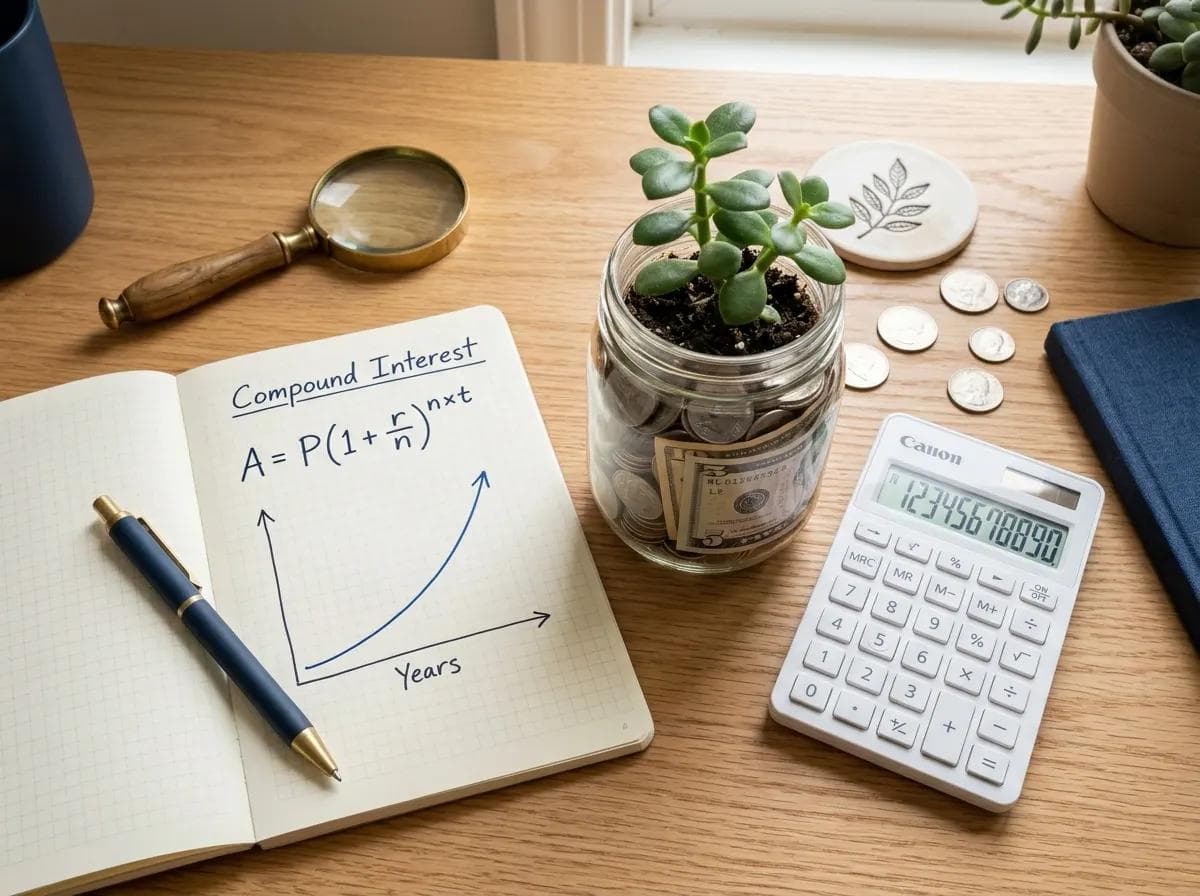
Compound interest works by adding earned interest back to the principal at regular intervals — the compounding period. Once added, that interest earns its own interest in every subsequent period. This creates an exponential curve where growth appears slow at first, then dramatically steepens in later years.
Here's the simplest illustration:
Year-by-Year Compounding on $10,000 at 7% (Annual)
| Year | Starting Balance | Interest Earned | Ending Balance |
|---|---|---|---|
| 1 | $10,000 | $700 | $10,700 |
| 5 | $13,108 | $918 | $14,026 |
| 10 | $18,385 | $1,287 | $19,672 |
| 20 | $33,869 | $2,371 | $36,240 |
| 30 | $66,144 | $4,630 | $70,774 |
Notice that the interest earned in year 30 ($4,630) is more than half the original $10,000 deposit — earned in a single year. This is the compounding effect: the longer it runs, the more each period contributes in absolute dollars.
Try the free Compound Interest Calculator now →
What Is the Compound Interest Formula?
The compound interest formula calculates the future value of an investment based on four inputs: principal, interest rate, compounding frequency, and time.
A = P × (1 + r/n)^(n×t)
Where:
- check_circleA = Final balance (principal + all earned interest)
- check_circleP = Principal (starting investment amount)
- check_circler = Annual interest rate as a decimal (e.g., 7% = 0.07)
- check_circlen = Number of compounding periods per year (12 for monthly, 365 for daily)
- check_circlet = Time in years
Worked Example
$5,000 invested at 6% annual interest, compounded monthly, for 10 years:
- check_circleP = $5,000
- check_circler = 0.06
- check_circlen = 12 (monthly)
- check_circlet = 10
A = 5,000 × (1 + 0.06/12)^(12 × 10) A = 5,000 × (1.005)^120 A = 5,000 × 1.8194 A = $9,097
Your $5,000 grew to $9,097 — earning $4,097 in compound interest over 10 years. If this were simple interest at the same rate, you'd earn only $3,000 in interest ($300/year × 10 years), finishing at $8,000. Compounding adds $1,097 more on the same starting amount over the same period.
For investments with regular contributions, the formula expands to include the future value of an annuity. This is where most calculators save significant time — automating dozens of sequential calculations into an instant result.
How Does Compounding Frequency Affect Growth?
More frequent compounding produces more growth because interest is added to your balance sooner — and starts earning its own interest earlier.
Here's how the same $10,000 at 5% annual interest grows over 10 years at different compounding frequencies:
| Compounding Frequency | Periods Per Year | Balance After 10 Years | Interest Earned |
|---|---|---|---|
| Annual | 1 | $16,289 | $6,289 |
| Quarterly | 4 | $16,436 | $6,436 |
| Monthly | 12 | $16,470 | $6,470 |
| Daily | 365 | $16,487 | $6,487 |
The difference between annual and daily compounding on $10,000 is $198 over 10 years at 5% — modest at this scale. But at higher balances or higher rates, the difference becomes meaningful. On a $100,000 portfolio at 7% over 30 years, daily compounding vs. annual compounding adds over $9,000 to the final balance.
Practical implication: When comparing savings accounts or investment products, look for the APY (Annual Percentage Yield), not just the APR. APY accounts for compounding frequency and gives you the true annualized return for comparison purposes — which is why the Truth in Savings Act requires banks to advertise APY.
Simple Interest vs. Compound Interest
Simple interest calculates returns only on the original principal, every period. Compound interest calculates returns on the principal plus all previously earned interest. The same rate produces very different outcomes over time.
| Factor | Simple Interest | Compound Interest |
|---|---|---|
| Calculated On | Principal only | Principal + accumulated interest |
| Growth Pattern | Linear (flat dollar amount per year) | Exponential (accelerating each period) |
| Formula | I = P × r × t | A = P(1 + r/n)^(n×t) |
| $10,000 at 6% / 20 years | $22,000 | $32,071 |
| $10,000 at 6% / 30 years | $28,000 | $57,435 |
| Best For | Short-term loans, clarity of cost | Long-term savings, investments |
| Common Use Cases | Auto loans, some personal loans | Savings accounts, investments, mortgages |
| Time Sensitivity | Low | Very high — time dramatically amplifies returns |
Over a long time horizon, history shows that a diversified growth portfolio can return an average of 6% annually. At that rate, a $10,000 investment grows to more than $57,000 after 30 years through compound interest, according to NerdWallet. Under simple interest at the same rate, the same investment reaches only $28,000 — less than half. The $29,000 gap is the dollar value of compounding over three decades.
How Does the Rule of 72 Work?
The Rule of 72 is a mental math shortcut that estimates how many years it takes for an investment to double: divide 72 by the annual interest rate.
Years to double = 72 ÷ Annual Interest Rate
| Annual Rate | Years to Double | $10,000 Becomes |
|---|---|---|
| 2% (savings account) | 36 years | $20,000 |
| 4% (bonds / CDs) | 18 years | $20,000 |
| 6% (diversified portfolio) | 12 years | $20,000 |
| 8% (growth portfolio) | 9 years | $20,000 |
| 10% (S&P 500 historical avg.) | 7.2 years | $20,000 |
| 12% (aggressive growth) | 6 years | $20,000 |
The Rule of 72 illustrates why the interest rate matters so much more than most investors realize. At 2%, your money doubles once in a typical 35-year career. At 10%, it doubles roughly five times — turning $10,000 into $320,000 over the same period. The difference between a 4% and 8% return isn't twice the money. It's four times the money.
How Can You Maximize Compound Interest?
Four variables control compound interest: rate, time, frequency, and regular contributions. Time is the most powerful.
1. Start as Early as Possible
The single most impactful decision is when you start. A 25-year-old investing $5,000 at 7% for 40 years accumulates $74,872. A 35-year-old investing the same $5,000 at the same rate for 30 years accumulates $38,061. The 10-year head start more than doubles the outcome on the same investment.
2. Reinvest All Earnings
Compound interest only works if earnings are reinvested, not withdrawn. Dividend reinvestment plans (DRIPs), growth ETFs, and tax-advantaged accounts like 401(k)s and Roth IRAs automatically reinvest returns — making reinvestment effortless. Every dollar withdrawn breaks the compounding chain.
3. Add Regular Contributions
Monthly contributions dramatically amplify the compounding effect. Adding $200/month to a $10,000 starting balance at 7% over 20 years produces approximately $115,000 — versus $38,697 from the lump sum alone. Regular contributions raise the base that compound interest works from every single month.
4. Maximize Tax-Advantaged Accounts First
Tax drag is compound interest's silent enemy. A 401(k) or Roth IRA lets your money compound on untaxed gains — meaning the full return stays in the account and compounds again next period. In a taxable account, capital gains and dividend taxes reduce the base each period, permanently slowing the compounding curve.
Model your 401(k) growth with our 401(k) Planner →
Investment Growth Summary Table
How $10,000 grows at different rates over different time horizons (annual compounding, no additional contributions):
| Starting Amount | Rate | 10 Years | 20 Years | 30 Years | 40 Years |
|---|---|---|---|---|---|
| $10,000 | 2% | $12,190 | $14,859 | $18,114 | $22,080 |
| $10,000 | 4% | $14,802 | $21,911 | $32,434 | $48,010 |
| $10,000 | 6% | $17,908 | $32,071 | $57,435 | $102,857 |
| $10,000 | 7% | $19,672 | $38,697 | $76,123 | $149,745 |
| $10,000 | 10% | $25,937 | $67,275 | $174,494 | $452,593 |
Key insight: The difference between a 6% and 10% average annual return on $10,000 over 40 years is $349,736. Rate of return — and the investment decisions that determine it — is worth far more than the initial amount invested.
What Is a Compound Interest Calculator?
A compound interest calculator computes the future value of your investment by applying the compound interest formula automatically across your chosen time horizon. Instead of working through the formula year by year, you input four values and get instant results.
What to enter:
- check_circlePrincipal — your starting amount
- check_circleAnnual interest rate — your expected return (use APY for savings accounts; use historical average or target return for investments)
- check_circleCompounding frequency — daily, monthly, quarterly, or annually
- check_circleTime period — years until you need the money
- check_circleRegular contributions (optional) — monthly or annual additions
What the calculator shows:
- check_circleFinal balance at the end of your time period
- check_circleTotal contributions made
- check_circleTotal interest earned
- check_circleYear-by-year growth breakdown
- check_circleVisual chart of growth curve over time
The Jamrotools Compound Interest Calculator runs all scenarios instantly and lets you adjust any variable to see how rate, time, frequency, and regular contributions each affect your outcome.
Try the free Compound Interest Calculator now →
Related Tools & Resources
- check_circleCompound Interest Calculator — Model any investment scenario with custom rate, time, and contribution inputs
- check_circle401(k) Planner — Project your retirement balance using compound growth with employer matching and contribution limits
- check_circleFirst-Time Homebuyer Checklist — See how compound interest principles apply to the rent vs. buy decision and mortgage payoff strategy
- check_circleMortgage Calculator Guide — Understand how compound interest works in reverse for debt through mortgage amortization
Final Thoughts
Compound interest is the most reliable wealth-building mechanism available to anyone with time and consistency. The formula never changes. The variables that control it — rate, time, frequency, and regular contributions — are all within your influence. Starting earlier matters more than starting with more. Staying invested matters more than picking the perfect entry point.
Use the Compound Interest Calculator to model your own scenarios. Enter your actual savings, your realistic return target, and your time horizon. The results often change how people prioritize saving — because seeing the curve makes the math personal.
Try the free Compound Interest Calculator now →
Disclaimer
This blog post is for informational purposes only and does not constitute financial, investment, or tax advice. Compound interest projections are mathematical estimates based on fixed assumed rates of return. Actual investment returns vary due to market conditions, inflation, fees, and taxes. Historical average returns are not guarantees of future performance. Past performance of any index, fund, or asset class does not predict future results. Consult a qualified financial advisor before making investment decisions.